
One office inside the State Bar of Georgia screens every grievance and decides who is investigated and who is cleared. This is how that office handled three people in three protected categories. The facts are from court opinions and the Bar’s own words. I am showing the documents. I am not assigning a motive.
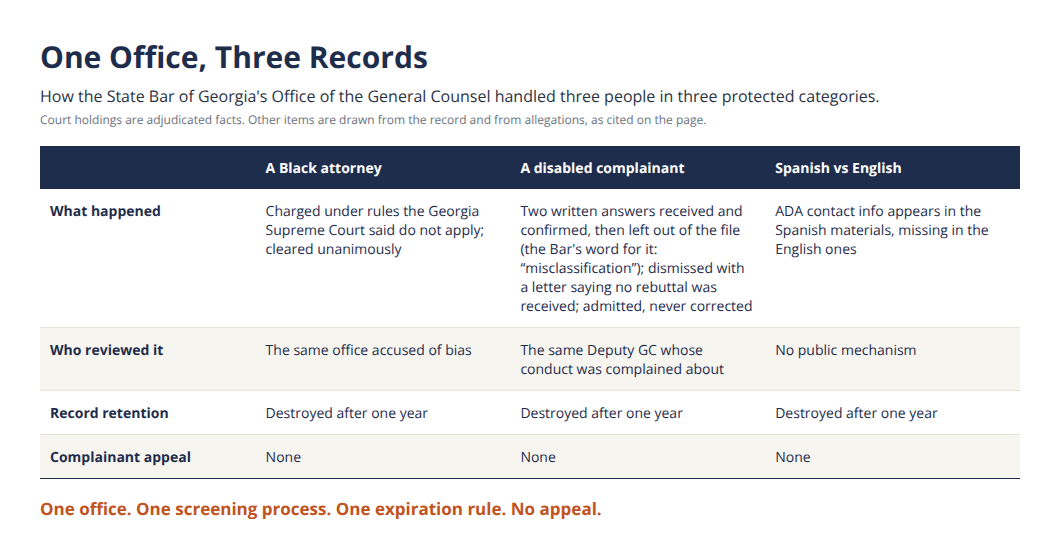
The graphic above, as text
| A Black attorney | A disabled complainant | Spanish vs English | |
|---|---|---|---|
| What happened | Charged under rules the Georgia Supreme Court said do not apply; cleared unanimously | Two written answers received and confirmed, then left out of the file (the State Bar of Georgia's word for it: "misclassification"); the dismissal letter said no rebuttal was received; admitted, never corrected | ADA contact information appears in the Spanish materials, missing in the English ones |
| Who reviewed it | The same office accused of bias | The same Deputy General Counsel whose conduct was complained about | No public mechanism |
| Record retention | Destroyed after one year | Destroyed after one year | Destroyed after one year |
| Complainant appeal | None | None | None |
One office. One screening process. One expiration rule. No appeal. Court holdings are adjudicated facts. Other items are drawn from the record and from allegations, as cited on this page.
1. One Day, Two Positions
May 12, 2026. A brief was filed in the Northern District of Georgia for the State Bar of Georgia’s Office of the General Counsel and two others. Page 19: “As the administrative arm of the Georgia Supreme Court, Defendants are entitled to qualified immunity.”
May 12, 2026, 2:12 PM. Deputy General Counsel William D. NeSmith III wrote to me on behalf of the State Bar of Georgia: “The State Bar of Georgia is not a public entity, such as a federal, state or local government department or agency.” The thread had carried eight other recipients. The reply came to me alone.
September 14, 2026. On September 14, 2026, both statements were filed in Ms. Mignott’s federal case.
I am not a party to her case. I filed nothing in it. This site takes no position on her claims. Title II and the Eleventh Amendment are different tests, and this page does not treat them as one. What the documents show is that the State Bar of Georgia described itself two ways on one day, and that both descriptions are now quoted in a federal filing.
2. A Black attorney charged under rules that did not reach her conduct
Marsha W. Mignott has been a member of the State Bar of Georgia since 2005, “without prior disciplinary history” (ABA Journal). The Office of the General Counsel charged her with violating Georgia Rules of Professional Conduct 1.8(b) and 1.9(c)(2). The Supreme Court of Georgia dismissed the case unanimously:
“By their plain text, Rules 1.8 (b) and 1.9 (c) (2) apply only to clients and former clients, not prospective clients.” … “We therefore impose no discipline and dismiss this matter.” … “All the Justices concur.”
The conduct dated to March 2018. The notice of probable cause issued in October 2020. The case was not dismissed until October 24, 2023.
Her federal suit cited a State Bar investigator’s email to a white attorney accused of misconduct. As reported by the ABA Journal, the investigator wrote (an allegation drawn from her complaint):
“As soon as I receive your response (you don’t have to go into great detail), I will draft a dismissal letter and send you a copy.”
Mignott filed a putative class action under 42 U.S.C. § 1981. The Eleventh Circuit, quoting her complaint, described the claim:
She alleged the defendants “discriminated against her and other black attorneys by pursuing ‘fraudulent grievances’ against them and by subjecting them ‘to unequal grievance and disciplinary proceedings relative to their white peers.’”
The Bar’s outside counsel responded: “The bar denies the allegations… Race plays no role in state bar disciplinary matters.” On July 30, 2025, the Eleventh Circuit (Pryor, C.J., published) vacated the dismissal of her suit:
“Because federal, not state, law governs the subject-matter jurisdiction of the district court, we vacate and remand for further proceedings.” … “Indeed, she prevailed in the Supreme Court of Georgia, which held that she did not violate any rule of professional conduct.”
The court expressly reserved the remaining questions, including immunity, for the district court. The case is alive on remand.
3. A disabled complainant: submissions misfiled, then my requests recast as seeking an outcome
A disabled member of the public filed a grievance against the lawyer. The Bar’s own intake confirmed receipt of his rebuttal submissions by grievance number, then dismissed the grievance stating no rebuttal had been received. It later admitted, in writing:
“As a result of this misclassification, your submissions were not added to the grievance file at that time.”
The dismissal was never corrected. When he invoked ADA access, a Deputy General Counsel wrote that his requests appeared “directed less toward obtaining accommodation or access assistance and more toward securing a particular substantive outcome regarding the underlying grievance matter.” On the same disability, in the same weeks, the Bar’s ADA Coordinator granted accommodations, then wrote that the Bar is “not subject to Title II.”
4. The language gap
Older Spanish-language grievance materials published by the Bar include ADA Coordinator contact information: a name, a phone number, a toll-free number. The current English-language grievance pathway publishes none of it. The Bar has not explained the discrepancy.
Sources
| Item | Source |
|---|---|
| “apply only to clients and former clients, not prospective clients”; “impose no discipline and dismiss”; “All the Justices concur” | Ga. Supreme Court, per curiam, In re Mignott, 893 S.E.2d 891 (Ga. Oct. 24, 2023) |
| “federal, not state, law governs the subject-matter jurisdiction… we vacate and remand”; her allegations of “fraudulent grievances” and “unequal grievance and disciplinary proceedings relative to their white peers”; immunity reserved | 11th Cir., published, Pryor, C.J., Mignott v. State Bar of Ga. Found., Inc., No. 24-10327 (11th Cir. July 30, 2025) |
| Investigator “draft a dismissal letter” email; “shine a light on the racial injustices”; “Race plays no role”; “without prior disciplinary history” | ABA Journal, Apr. 25, 2023 |
| “your submissions were not added to the grievance file at that time” | Bar correspondence, Apr 21 / May 5, 2026 |
| “directed less toward obtaining accommodation… more toward securing a particular substantive outcome” | Bar correspondence, May 12, 2026 |
| “not subject to Title II” | Bar correspondence, May 29, 2026 |
Related on this site
- A grievance against an outside lawyer gets a number, a reviewer, and a decision. Grievances against its own get weeks of nothing.
- The Bar admitted in writing it misfiled my submissions. The dismissal built on that error still stands.
- Other bars publish an ADA way in for disabled people. Georgia says it is “not required to.”
- Another Georgia agency acknowledged me in eight days, by name, with a case number. The Bar misfiled the file.
- The full State Bar of Georgia story
Court holdings are adjudicated facts. The investigator email and the racial-discrimination claims are Marsha Mignott’s allegations, as reported and as quoted in her complaint; her federal case is ongoing on remand, with immunity and the merits unresolved. Corrections: if any fact here is incomplete or inaccurate, identify the page, the sentence, and the supporting source, and I will review and correct this page.