TYPED REPRODUCTIONA rendering of the email’s text, from the native message
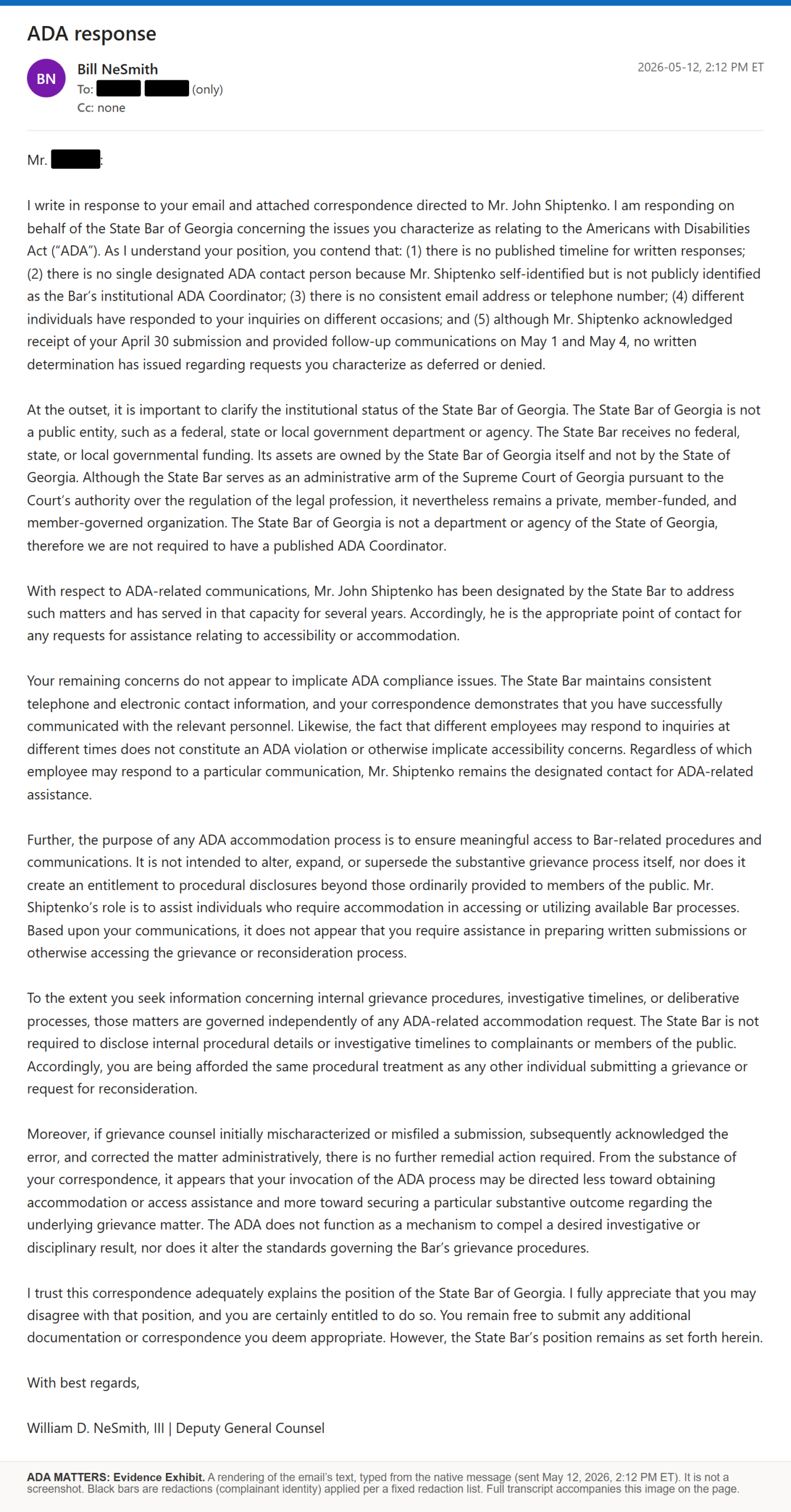
Date: May 12, 2026, 2:12 PM ET
From: Deputy General Counsel William D. NeSmith III
To: The complainant (only)
To / Cc: (all institutional recipients removed)
Subject: ADA response
Transcript (redacted):
> [Salutation withheld]:
>
> I write in response to your email and attached correspondence directed to Mr. John Shiptenko. I am responding on behalf of the State Bar of Georgia concerning the issues you characterize as relating to the Americans with Disabilities Act (“ADA”). As I understand your position, you contend that: (1) there is no published timeline for written responses; (2) there is no single designated ADA contact person because Mr. Shiptenko self-identified but is not publicly identified as the Bar’s institutional ADA Coordinator; (3) there is no consistent email address or telephone number; (4) different individuals have responded to your inquiries on different occasions; and (5) although Mr. Shiptenko acknowledged receipt of your April 30 submission and provided follow-up communications on May 1 and May 4, no written determination has issued regarding requests you characterize as deferred or denied.
>
> At the outset, it is important to clarify the institutional status of the State Bar of Georgia. The State Bar of Georgia is not a public entity, such as a federal, state or local government department or agency. The State Bar receives no federal, state, or local governmental funding. Its assets are owned by the State Bar of Georgia itself and not by the State of Georgia. Although the State Bar serves as an administrative arm of the Supreme Court of Georgia pursuant to the Court’s authority over the regulation of the legal profession, it nevertheless remains a private, member-funded, and member-governed organization. The State Bar of Georgia is not a department or agency of the State of Georgia, therefore we are not required to have a published ADA Coordinator.
>
> With respect to ADA-related communications, Mr. John Shiptenko has been designated by the State Bar to address such matters and has served in that capacity for several years. Accordingly, he is the appropriate point of contact for any requests for assistance relating to accessibility or accommodation.
>
> Your remaining concerns do not appear to implicate ADA compliance issues. The State Bar maintains consistent telephone and electronic contact information, and your correspondence demonstrates that you have successfully communicated with the relevant personnel. Likewise, the fact that different employees may respond to inquiries at different times does not constitute an ADA violation or otherwise implicate accessibility concerns. Regardless of which employee may respond to a particular communication, Mr. Shiptenko remains the designated contact for ADA-related assistance.
>
> Further, the purpose of any ADA accommodation process is to ensure meaningful access to Bar-related procedures and communications. It is not intended to alter, expand, or supersede the substantive grievance process itself, nor does it create an entitlement to procedural disclosures beyond those ordinarily provided to members of the public. Mr. Shiptenko’s role is to assist individuals who require accommodation in accessing or utilizing available Bar processes. Based upon your communications, it does not appear that you require assistance in preparing written submissions or otherwise accessing the grievance or reconsideration process.
>
> To the extent you seek information concerning internal grievance procedures, investigative timelines, or deliberative processes, those matters are governed independently of any ADA-related accommodation request. The State Bar is not required to disclose internal procedural details or investigative timelines to complainants or members of the public. Accordingly, you are being afforded the same procedural treatment as any other individual submitting a grievance or request for reconsideration.
>
> Moreover, if grievance counsel initially mischaracterized or misfiled a submission, subsequently acknowledged the error, and corrected the matter administratively, there is no further remedial action required. From the substance of your correspondence, it appears that your invocation of the ADA process may be directed less toward obtaining accommodation or access assistance and more toward securing a particular substantive outcome regarding the underlying grievance matter. The ADA does not function as a mechanism to compel a desired investigative or disciplinary result, nor does it alter the standards governing the Bar’s grievance procedures.
>
> I trust this correspondence adequately explains the position of the State Bar of Georgia. I fully appreciate that you may disagree with that position, and you are certainly entitled to do so. You remain free to submit any additional documentation or correspondence you deem appropriate. However, the State Bar’s position remains as set forth herein.
>
> With best regards,
>
> William D. NeSmith, III | Deputy General Counsel
What this shows: The Deputy General Counsel wrote that the Bar “is not a public entity,” that it is “not required to have a published ADA Coordinator,” and that the complainant’s “invocation of the ADA process may be directed less toward obtaining accommodation or access assistance and more toward securing a particular substantive outcome regarding the underlying grievance matter,” days after another Bar official had granted accommodations.
Related: The State Bar of Georgia’s lawyers later called this email “purporting” in a federal court brief. Read the entry.
May 12, 2026: NeSmith Denies ADA Coverage in an Email to Me Alone
Editor’s note, September 19, 2026: The Deputy General Counsel’s email referred to here as May 11 is dated May 12, 2026, 2:12 PM, in the original record. The letters are reproduced as sent.
NeSmith issued a written ADA-coverage denial at 2:12 PM, sent to me only with all institutional recipients stripped. At 6:37 PM NeSmith sent a one-line meeting offer (“I am available at 11.30 only”), again to me only. I sent two emails: a forward to the President asking whether NeSmith’s letter is the Bar’s official position, and a formal response to NeSmith restoring the cc list. Late that evening (8:54 PM) I accepted the meeting and made access requests.
What had to be true
For NeSmith’s denial to stand, the Bar had to take the position that it is “not a public entity” subject to Title II, directly opposite to Shiptenko granting accommodations days earlier. For me to ask “who speaks for the Bar,” two officials had to be writing contradictory positions about the same case.
What I argued
- Asked the President to confirm in writing “whether Mr. NeSmith’s letter is the official position of the State Bar of Georgia.”
- Rejected the motive accusation: “I did not invoke ADA access to force a disciplinary outcome.” “I did not lose the evidence. I did not misclassify the evidence… The Bar did.”
- Asked whether the Bar agrees it is “not a Title II public entity” and has “no obligation to publish an ADA Coordinator.”
- Demanded the Bar state whether the April 10 dismissal is “operative, vacated, superseded, or under reconsideration.”
- (Evening) Requested use of assistive note-taking software in the meeting under “28 C.F.R. Section 35.160(b)(1) effective communication and Section 35.130(b)(7) reasonable modification,” a single institutional point of contact, and “Please do not transmit further correspondence in this matter to me alone.”
What the Bar said
NeSmith (2:12 PM): “The State Bar of Georgia is not a public entity,” “we are not required to have a published ADA Coordinator,” “it does not appear that you require assistance in preparing written submissions,” and “it appears that your invocation of the ADA process may be directed less toward obtaining accommodation or access assistance and more toward securing a particular substantive outcome regarding the underlying grievance matter.” NeSmith (6:37 PM): “I am available at 11.30 only.”
The documents from this day
- May 12, 2026: NeSmith Writes the Bar Is “Not a Public Entity”
- I forwarded the Deputy General Counsel’s ADA denial and asked leadership to confirm the Bar’s position
- I answered the Bar’s claim that it is not subject to the ADA
- The Deputy General Counsel replied on the Bar’s ADA position
- I confirmed the meeting and asked for the access and dial-in details
May 12, 2026: NeSmith Writes the Bar Is “Not a Public Entity”
Correction, September 22, 2026: this transcript now reproduces the text of the original email as received on May 12, 2026, 2:12 PM. An earlier transcript on this page did not match the original in its later paragraphs. On September 28, 2026, the email image above was replaced with a rendering typed from the native email. The earlier image was not an accurate rendering: several of its paragraphs are not in the email, and several of the email’s paragraphs were missing. The earlier image, which does not match the email, is kept here so you can compare.
William D. NeSmith III Wrote the Bar Is “Not a Public Entity”
The Moving Target. A running log of the State Bar of Georgia’s stated position on whether the ADA applies to it. Each entry is the Bar’s own words, with the date.
May 12, 2026.
Eight days after one State Bar of Georgia official granted my disability accommodations, another wrote that the Bar is “not a public entity” and “not required to have a published ADA Coordinator.”
On May 4, the ADA Coordinator, John J. Shiptenko, granted written-only communication and accessible-format documents, and wrote that the Bar wanted me to have “the same rights and opportunities as non-disabled grievants.”
On May 12, Deputy General Counsel William D. NeSmith III answered the access correspondence differently. He wrote:
“The State Bar of Georgia is not a public entity, such as a federal, state or local government department or agency.” Four sentences later: “The State Bar of Georgia is not a department or agency of the State of Georgia, therefore we are not required to have a published ADA Coordinator.”
“it does not appear that you require assistance in preparing written submissions.”
My ADA request “may be directed less toward obtaining accommodation or access assistance and more toward securing a particular substantive outcome regarding the underlying grievance matter.”
I responded the same day, restored the full copy list the message had stripped, and requested a substantive response by the May 14 deadline.
The documents
| Date / Time | Direction | From | To / Cc | Document | Attachment | What it shows |
|---|---|---|---|---|---|---|
| May 4, 2026 | Received | John J. Shiptenko | the complainant | Accommodations granted | None | Granted written-only communication and accessible format; “the same rights and opportunities as non-disabled grievants.” |
| May 12, 2026, 2:12 PM | Received | William D. NeSmith III | the complainant (only) | Title II denial | None | “not a public entity”; “not required to have a published ADA Coordinator”; the institutional cc list removed. |
| May 12, 2026, 6:37 PM | Received | William D. NeSmith III | the complainant (only) | Meeting offer | None | A one-line “I am available at 11.30 only,” sent to the complainant alone. |
| May 12, 2026, 3:40 PM | Sent | the complainant | NeSmith + full leadership | Response restoring the facts | Response (PDF) | Restored the full institutional copy list and requested a substantive response by May 14. |
The questions still open
Is the State Bar subject to Title II, yes or no, and who speaks for the Bar on that question? See The Unanswered Questions.
Read the emails and letters: the full State Bar of Georgia story, and this day on the Timeline.
Corrections: this site is built from the documents I received. If any fact here is incomplete or inaccurate, identify the page, the sentence, and the supporting document, and I will review and correct this page.
Patterns on this page: accommodation-then-undermined, stripped-cc, two-tier. Each is a recurring pattern in the State Bar record. We are noting the timing, not asserting a reason.