
The Bar Record
The Bar Moved the Goalpost
Every time I asked for access, accommodation, or help, the answer changed.
- First there was no visible ADA route.
- Then an ADA contact appeared.
- Then accommodations were granted.
- Then the Bar said it was reviewing its ADA notices and processes.
- Then the Bar said Title II did not apply.
- Then it questioned whether I needed help.
- Then it treated my private workaround as the accommodation.
The goal was access.
The goalpost was the Bar.
Florida published the door.
Georgia moved the football.
See the Florida comparator: what I expected, what I got →
What the Bar Did Besides “Help”
The Bar can point to a few things that sound helpful. Here is the rest of the documents.
1 Dismissed the grievance on a file that did not contain the rebuttal materials
The April 10 dismissal said no rebuttal had been received. The Bar later admitted, in writing, that my February 3 and February 20 submissions were received, misclassified, and not added to the grievance file when the dismissal was reviewed.
📄 Read it: the Bar admitted the submissions were received but not added to the file
The system received the response. The file did not.
2 Admitted the file problem, but did not correct the dismissal
The Assistant General Counsel admitted the submissions were received and, in her own words, “not added to the grievance file at that time.” The dismissal that issued on their absence was not withdrawn, superseded, or corrected.
The admission solved the mystery. It did not fix the file.
3 Turned a correction request into reconsideration
I did not ask the Bar to change its mind. I asked it to correct a record that had issued before timely materials were placed in the file. The Bar moved the problem into reconsideration instead of fixing it.
I asked them to correct the file. They moved it into reconsideration.
4 Declared the file complete, without answering “complete for what?”
The Bar stated the file was considered complete and that my participation was not required. A complete file is not a cure if the defective dismissal still does the work of a complete-record decision.
They gave me a filing cabinet. They did not say whether anyone planned to open it.
5 Failed to publish a visible ADA route in the grievance process
The public complaint pathway and the grievance landing page carried no ADA Coordinator mention, no disability-accommodation offer, no alternative-format option, and no public notice. The only ADA Coordinator reference sat on a legacy PDF, phone-only to contact, mail-only to file.
The door existed only if you already knew where to look.
6 Made the accommodation route conditional
The Bar’s ADA contact identified himself as the coordinator for my case, but also said the office did not need further information from me at that stage, and that accommodation requests should come to him only if the office later contacted me.
Access was treated as something I could ask for only if they later decided they needed me.
7 Denied Title II coverage after performing ADA functions
One Deputy General Counsel wrote that the State Bar was not a public entity and was not required to have a published ADA Coordinator. The same record shows the Bar’s own ADA contact saying the Bar had more than one ADA Coordinator, that he was one of them, and that the Bar engaged in the interactive process.
📄 Read it: the written Title II coverage denial
One lawyer said the door did not exist. Another was standing in it.
8 William D. NeSmith III, May 12, 2026: “It Does Not Appear That You Require Assistance”
On May 12, 2026, William D. NeSmith III, Deputy General Counsel, State Bar of Georgia, wrote: “Based upon your communications, it does not appear that you require assistance in preparing written submissions or otherwise accessing the grievance or reconsideration process.”
He judged my need for help from emails I wrote with voice software.
9 Made the access problem so bad I had to contact the State ADA Office, then still did not identify a public fix
The access problem did not stay inside the Bar. It became unclear and unanswered enough that I had to put the Georgia State ADA Coordinator’s Office in writing.
After that, the tone changed. The Bar granted accommodations, spoke in ADA language, and said it was reviewing its ADA notices and processes. Then it denied Title II coverage anyway, questioned whether I needed assistance, and removed the State ADA Coordinator from later communications. As of the date of this page, no public-facing ADA route for the Bar’s own grievance process has been identified.
The Bar reviewed its ADA notices. The public still could not find the door.
The question is no longer whether the Bar knew.
The question is what changed after it knew.
ADA Accommodations Granted. ADA Accommodations Taken Away.
The Bar put accommodations in writing, and then, also in writing, took the ground out from under each one.
- Written communication May 4
- Accessible electronic formats May 4
- “Approved your accommodation request” May 13
- An ADA contact engaged on the case May 4
- The law behind the accommodations, denied twice: “not a public entity” May 12 and “not subject to Title II” May 29
- The recipients, stripped from replies again and again, leaving a disabled man to rebuild the distribution list himself May 12
- The correspondence itself, shut down May 15
- My role on my own case, narrowed to “accommodation requests only” June 2
- The contact, out of office at escalation points, the case sent elsewhere June 2
- The offered accommodation, the voice-to-text software I had already paid thousands for June 17
- The accessible route in, the same flagged form re-sent, CAPTCHA and all May 26
Georgia Bar Granted My ADA Access, Then Said “Not a Public Entity”
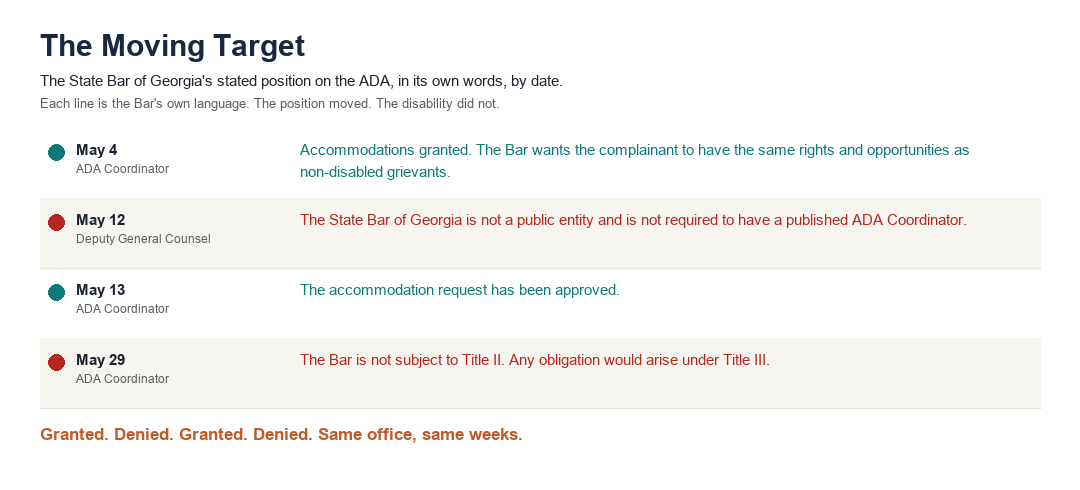
The Moving Target. A running log of the State Bar of Georgia’s stated position on whether the ADA applies to it. Each entry is the Bar’s own words, with the date.
May 4 to May 29, 2026.
In 25 days the State Bar of Georgia granted my ADA accommodations, then wrote that it is “not a public entity” subject to the ADA, then approved the accommodations again, then wrote that it is not subject to Title II.
These are the Bar’s own words, in order. On May 4 it granted accommodations and said it wanted me to have the same rights and opportunities as non-disabled grievants. On May 12 the Deputy General Counsel wrote:
“The State Bar of Georgia is not a public entity, such as a federal, state or local government department or agency.” Four sentences later: “The State Bar of Georgia is not a department or agency of the State of Georgia, therefore we are not required to have a published ADA Coordinator.”
On May 13 the Bar approved the accommodation request again. On May 29 it wrote that it is not subject to Title II and that any obligation would arise under Title III.
“Does Title II apply, yes or no.”
What it costs me
“I write every one of these letters with voice software because [disability detail withheld].”
Read the emails and letters: the full State Bar of Georgia story, and this day on the Timeline.
Patterns on this page: accommodation-then-undermined, breaks-its-own-rules, cost-on-the-disabled. Each is a recurring pattern in the State Bar record. I am noting it, not asserting a reason.
Corrections: this is built from documents I received. If any fact here is incomplete or inaccurate, identify the page, the sentence, and the supporting document, and I will review and correct this page.