The Story · State Bar of Georgia
On May 4, 2026, John J. Shiptenko, Senior Assistant General Counsel of the State Bar of Georgia, granted my request for written communication and readable documents. On May 29, 2026, the same lawyer wrote that the State Bar of Georgia is not subject to Title II, the part of the Americans with Disabilities Act that applies to government. Seventeen days before that, its own lawyers had told a federal court the State Bar of Georgia is the administrative arm of the Georgia Supreme Court. Proof of John J. Shiptenko’s May 29 answer
If you know nothing about this, start here
The Americans with Disabilities Act has parts. Title II covers state and local government: courts, agencies, police, public offices. Title III covers businesses open to the public: stores, hotels, restaurants. Title II is the stronger one for a person asking a public body for access. The State Bar of Georgia decides every complaint about every lawyer in Georgia. It told me it is a Title III business, not a Title II government body.
What the State Bar of Georgia said, and when, as of May 29, 2026
| Date in 2026 | Who | What was written |
|---|---|---|
| May 4 | John J. Shiptenko, State Bar of Georgia | Granted written communication and accessible electronic documents, with exceptions for scanned files |
| May 12 | William D. NeSmith III, Deputy General Counsel, State Bar of Georgia | Wrote the State Bar of Georgia “is not a public entity” and is not required to have a published ADA Coordinator |
| May 12 | The State Bar of Georgia’s lawyers, in federal court | Wrote the State Bar of Georgia is “the administrative arm of the Georgia Supreme Court” |
| May 27 | Me | Asked John J. Shiptenko, yes or no: does Title II apply to access to the grievance process? |
| May 29 | John J. Shiptenko, State Bar of Georgia | “not subject to Title II”; any ADA duty would be under Title III; still willing to honor reasonable accommodations |
The one line to remember
“To be clear, the State Bar’s position remains that it is not subject to Title II of the Americans with Disabilities Act.”
John J. Shiptenko, Senior Assistant General Counsel, State Bar of Georgia, May 29, 2026. Read the receipt
Set it beside what the State Bar of Georgia’s own lawyers filed in federal court on May 12, 2026: “As the administrative arm of the Georgia Supreme Court, Defendants are entitled to qualified immunity.” the State Bar of Georgia called itself private to me and “the administrative arm of the Georgia Supreme Court” to a court
Two different legal tests sit behind those two sentences. Title II of the Americans with Disabilities Act reaches a “public entity,” defined at 42 U.S.C. 12131. The Eleventh Amendment protects an “arm of the state,” decided by a separate four factor test. A body can fail one and satisfy the other. This page draws no conclusion on either. It shows the two descriptions, the two audiences, and the one day.
The help he granted on May 4
“The OGC is granting the following ADA accommodations requested by you:”
Two things, in plain words. One: the State Bar of Georgia would deal with me in writing, “No telephone-only communications.” Two: documents the office created would come as readable text, “Plain text or accessible PDF, not scanned image-only PDF.” Old scans already in its system could still come as scans. Proof of Shiptenko’s May 4 grant and its document exceptions
John J. Shiptenko also wrote that his ADA role did not include reviewing my grievance, and named Adrienne D. Nash, Grievance Counsel, for questions about my file.
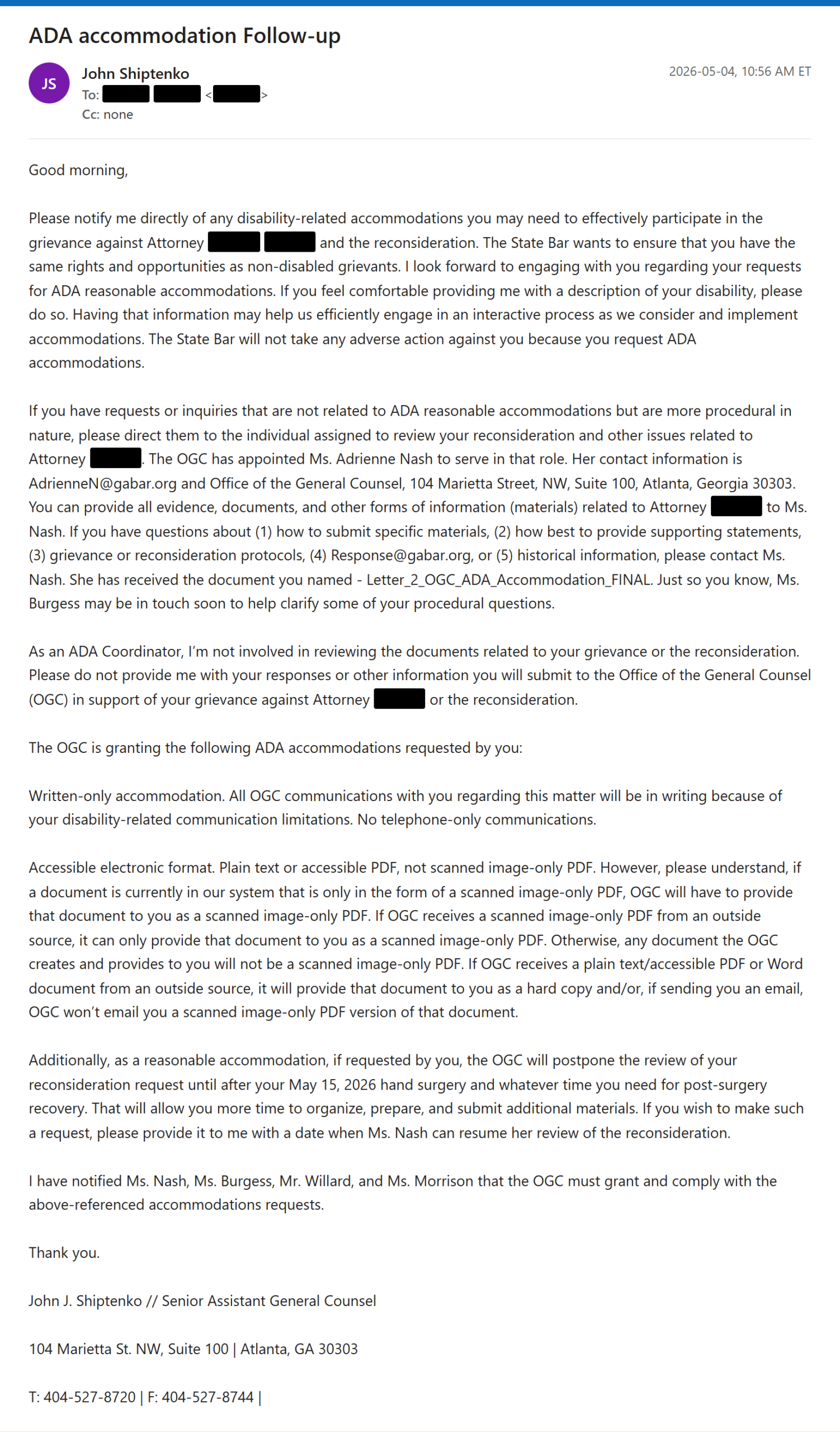
Read the text transcript
From: John Shiptenko
To: [my name removed]
Sent: May 4, 2026, 10:56 AM ET
Subject: ADA accommodation Follow-up
Good morning,
Please notify me directly of any disability-related accommodations you may need to effectively participate in the grievance against Attorney [name removed] and the reconsideration. The State Bar wants to ensure that you have the same rights and opportunities as non-disabled grievants. I look forward to engaging with you regarding your requests for ADA reasonable accommodations. If you feel comfortable providing me with a description of your disability, please do so. Having that information may help us efficiently engage in an interactive process as we consider and implement accommodations. The State Bar will not take any adverse action against you because you request ADA accommodations.
If you have requests or inquiries that are not related to ADA reasonable accommodations but are more procedural in nature, please direct them to the individual assigned to review your reconsideration and other issues related to Attorney [name removed]. The OGC has appointed Ms. Adrienne Nash to serve in that role. Her contact information is AdrienneN@gabar.org and Office of the General Counsel, 104 Marietta Street, NW, Suite 100, Atlanta, Georgia 30303. You can provide all evidence, documents, and other forms of information (materials) related to Attorney [name removed] to Ms. Nash. If you have questions about (1) how to submit specific materials, (2) how best to provide supporting statements, (3) grievance or reconsideration protocols, (4) Response@gabar.org, or (5) historical information, please contact Ms. Nash. She has received the document you named – Letter_2_OGC_ADA_Accommodation_FINAL. Just so you know, Ms. Burgess may be in touch soon to help clarify some of your procedural questions.
As an ADA Coordinator, I’m not involved in reviewing the documents related to your grievance or the reconsideration. Please do not provide me with your responses or other information you will submit to the Office of the General Counsel (OGC) in support of your grievance against Attorney [name removed] or the reconsideration.
The OGC is granting the following ADA accommodations requested by you:
Written-only accommodation. All OGC communications with you regarding this matter will be in writing because of your disability-related communication limitations. No telephone-only communications.
Accessible electronic format. Plain text or accessible PDF, not scanned image-only PDF. However, please understand, if a document is currently in our system that is only in the form of a scanned image-only PDF, OGC will have to provide that document to you as a scanned image-only PDF. If OGC receives a scanned image-only PDF from an outside source, it can only provide that document to you as a scanned image-only PDF. Otherwise, any document the OGC creates and provides to you will not be a scanned image-only PDF. If OGC receives a plain text/accessible PDF or Word document from an outside source, it will provide that document to you as a hard copy and/or, if sending you an email, OGC won’t email you a scanned image-only PDF version of that document.
Additionally, as a reasonable accommodation, if requested by you, the OGC will postpone the review of your reconsideration request until after your May 15, 2026 hand surgery and whatever time you need for post-surgery recovery. That will allow you more time to organize, prepare, and submit additional materials. If you wish to make such a request, please provide it to me with a date when Ms. Nash can resume her review of the reconsideration.
I have notified Ms. Nash, Ms. Burgess, Mr. Willard, and Ms. Morrison that the OGC must grant and comply with the above-referenced accommodations requests.
Thank you.
John J. Shiptenko
// Senior Assistant General Counsel
104 Marietta St. NW, Suite 100 | Atlanta, GA 30303
T: 404-527-8720 | F: 404-527-8744 |
Typed from the native message. Names, my contact details and file numbers are removed and marked in brackets. Nothing else is changed.
I said thank you. I meant it. Then I asked one question.
The question, and the answer
On May 27, 2026, I asked John J. Shiptenko in writing whether Title II applies to access to the State Bar of Georgia’s grievance process. Yes or no.
On May 29 he answered. No. In the same email:
“To the extent that it has ADA obligations, the State Bar’s position is that such obligations would arise under Title III rather than Title II.”
“The Bar remains willing to honor any reasonable accommodation relating to access to the grievance process itself.”
He also wrote that my email was mostly legal argument rather than a new accommodation request, and sent the legal questions to William D. NeSmith III. Proof of John J. Shiptenko’s May 29, 2026 Title II answer
So the position of the State Bar of Georgia, in its own words, is: we will help you if we feel like it, and the law that would make us is not our law.
What I allege
1. I allege that John J. Shiptenko granted me real help on May 4, 2026, in writing, and that I am not taking that away from him. Two named accommodations. The email is linked above.
2. I allege that on May 29, 2026, the same man wrote that the State Bar of Georgia “is not subject to Title II.” Title II is the part of the ADA that applies to government. The State Bar of Georgia is the body Georgia uses to police every lawyer in the state.
3. I allege that on May 12, 2026, William D. NeSmith III, Deputy General Counsel, wrote that the State Bar of Georgia “is not a public entity, such as a federal, state or local government department or agency,” and on that same day the State Bar of Georgia’s lawyers told a federal court it is “the administrative arm of the Georgia Supreme Court.” Two audiences. Two descriptions. One institution. One day.
4. To a disabled man asking for access: a private body. To a federal judge: the administrative arm of the state’s highest court. Same institution. Same day. Two descriptions. Which one is the State Bar of Georgia? I am not a lawyer. I can read.
5. “Willing to honor any reasonable accommodation” while denying the law that requires it is a favor, not a right. A favor can be withdrawn. On May 15, 2026, the State Bar of Georgia wrote it would not engage in further substantive correspondence with me. May 15, 2026, Bar “will not engage in further substantive correspondence” That is what a favor looks like when it is tired of you.
6. Was the State Bar of Georgia’s Title II answer about me, or about never being on the hook, in writing, to the next disabled person who asks? I asked a yes or no question so the answer would be on paper. It is.
Is this how they would treat their own family or friends that were disabled
Questions and answers
Did the State Bar of Georgia grant accommodations? Yes. On May 4, 2026, John J. Shiptenko granted written communication and accessible electronic documents, with exceptions for files already scanned.
Did the State Bar of Georgia say Title II of the ADA applies to it? No. On May 29, 2026, John J. Shiptenko wrote that the State Bar of Georgia’s position is that it is not subject to Title II, and that any ADA duty would be under Title III.
What is the difference between Title II and Title III? Title II covers state and local government. Title III covers private businesses open to the public. This page reports what the State Bar of Georgia wrote. It does not decide which part of the law a court would apply. What Is ADA Title II? The Rules, in the Government’s Own Words
Read the documents
I am not asking you to take my word for any of it. I am asking you to read theirs.
Proof of John J. Shiptenko’s May 4, 2026 grant · Proof of John J. Shiptenko’s May 29, 2026 Title II answer · Proof of William D. NeSmith III’s May 12, 2026 position · The State Bar of Georgia called itself private, its lawyers told a court the State controls it · The Receipts
Corrections
ADA Matters welcomes documented corrections. Identify this page, the sentence and the supporting document so it can be reviewed.