The Story · State Bar of Georgia
On May 12, 2026, William D. NeSmith III, Deputy General Counsel of the State Bar of Georgia, wrote that it did not appear I needed help, and that my request for help looked aimed at winning my complaint. He judged that from my emails. Twenty one days earlier his own office had admitted in writing that it left my answers out of my file. Proof of William D. NeSmith III’s May 12, 2026 email
If you know nothing about this, start here
I am a disabled dad. I use voice software to write. I asked the State Bar of Georgia, the body that decides complaints about Georgia lawyers, for help taking part in my own complaint after it admitted it had left my written answers out of my file. The lawyer who answered did not ask for my medical paperwork. He read my emails and decided I was fine.
The order of events, as of May 12, 2026
| Date in 2026 | Who | What happened |
|---|---|---|
| April 21 | Leigh Burgess, Assistant General Counsel, State Bar of Georgia | Admitted my two answers were left out of my file and said they had now been added |
| April 30 | Me | Asked the State ADA Coordinator’s Office for help, State Bar of Georgia copied, and offered my medical documentation |
| May 4 and May 7 | John J. Shiptenko, Senior Assistant General Counsel, State Bar of Georgia | Granted written communication on May 4; asked, twice, whether I felt comfortable describing my disability |
| May 12 | William D. NeSmith III, Deputy General Counsel, State Bar of Georgia | Wrote that it did not appear I needed help, and that my request looked aimed at the outcome of my complaint |
The one line to remember
“Based upon your communications, it does not appear that you require assistance in preparing written submissions or otherwise accessing the grievance or reconsideration process.”
William D. NeSmith III, Deputy General Counsel, State Bar of Georgia, May 12, 2026. Read the receipt
He judged my need for help from emails I wrote with voice software. My emails existed because I was trying to get his office to handle my emails properly.
I offered the paperwork. Nobody asked for it.
On April 30, 2026, I asked for help in one message to the State ADA Coordinator’s Office, with the State Bar of Georgia copied. My offer was in it, in these words:
“Medical documentation is available upon request and should be handled confidentially.” (Me, April 30, 2026. Proof of my April 30, 2026 request for help)
John J. Shiptenko, Senior Assistant General Counsel, State Bar of Georgia, wrote back on May 4 and again on May 7, 2026:
“If you feel comfortable providing me with a description of your disability, please do so.”
The same lawyer granted written communication on May 4, and that belongs here. Proof of what John J. Shiptenko granted on May 4, 2026
Then William D. NeSmith III wrote on May 12. His email did not ask to see the documentation I had offered. It said this:
“You remain free to submit any additional documentation or correspondence you deem appropriate.”
Permission to send more is not a request to see what I offered.
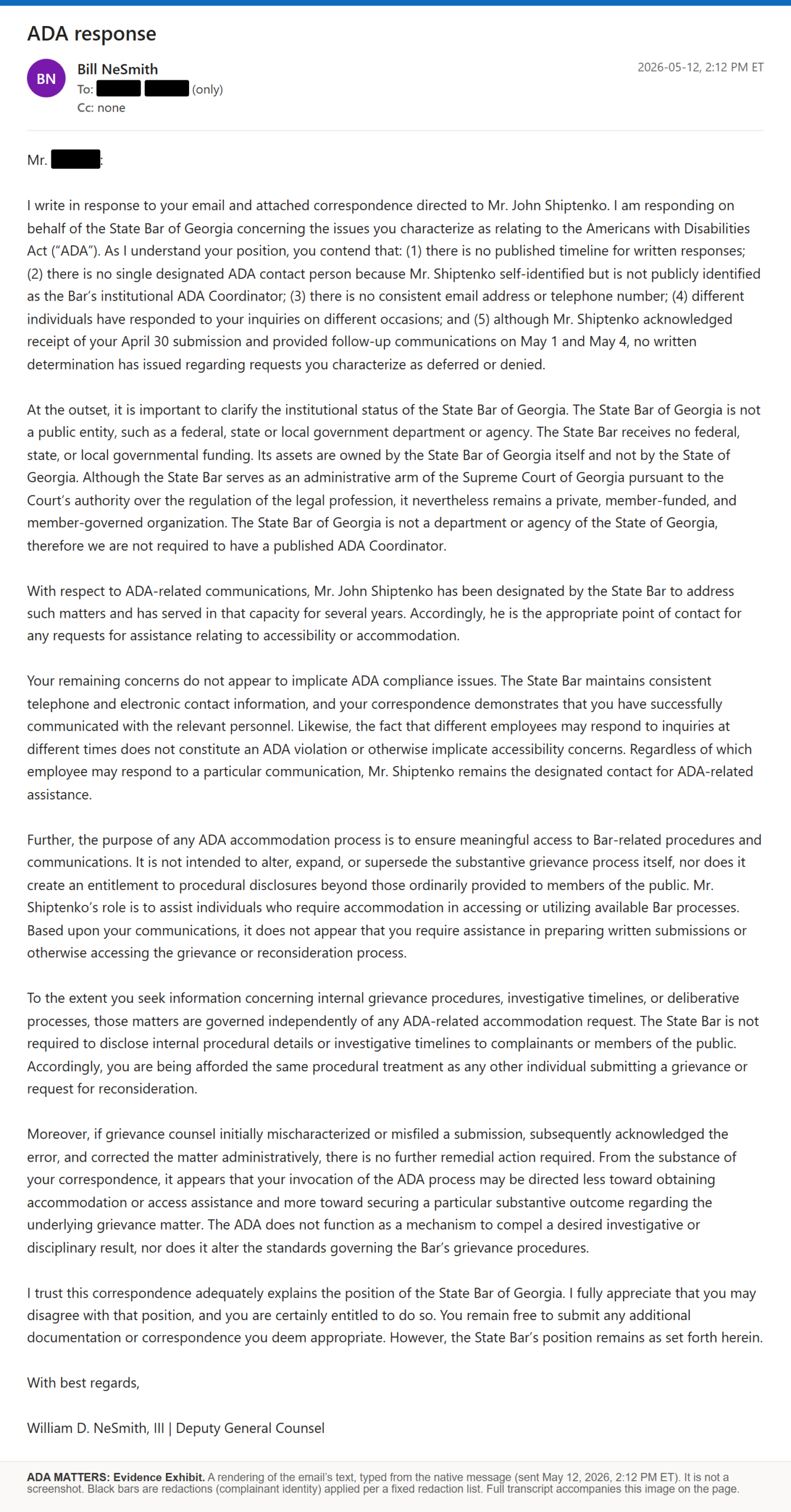
Read the text transcript
From: Bill NeSmith
To: [my name removed]
Sent: May 12, 2026, 2:12 PM ET
Subject: ADA response
Mr. [my name removed]:
I write in response to your email and attached correspondence directed to Mr. John Shiptenko. I am responding on behalf of the State Bar of Georgia concerning the issues you characterize as relating to the Americans with Disabilities Act (“ADA”). As I understand your position, you contend that: (1) there is no published timeline for written responses; (2) there is no single designated ADA contact person because Mr. Shiptenko self-identified but is not publicly identified as the Bar’s institutional ADA Coordinator; (3) there is no consistent email address or telephone number; (4) different individuals have responded to your inquiries on different occasions; and (5) although Mr. Shiptenko acknowledged receipt of your April 30 submission and provided follow-up communications on May 1 and May 4, no written determination has issued regarding requests you characterize as deferred or denied.
At the outset, it is important to clarify the institutional status of the State Bar of Georgia. The State Bar of Georgia is not a public entity, such as a federal, state or local government department or agency. The State Bar receives no federal, state, or local governmental funding. Its assets are owned by the State Bar of Georgia itself and not by the State of Georgia. Although the State Bar serves as an administrative arm of the Supreme Court of Georgia pursuant to the Court’s authority over the regulation of the legal profession, it nevertheless remains a private, member-funded, and member-governed organization. The State Bar of Georgia is not a department or agency of the State of Georgia, therefore we are not required to have a published ADA Coordinator.
With respect to ADA-related communications, Mr. John Shiptenko has been designated by the State Bar to address such matters and has served in that capacity for several years. Accordingly, he is the appropriate point of contact for any requests for assistance relating to accessibility or accommodation.
Your remaining concerns do not appear to implicate ADA compliance issues. The State Bar maintains consistent telephone and electronic contact information, and your correspondence demonstrates that you have successfully communicated with the relevant personnel. Likewise, the fact that different employees may respond to inquiries at different times does not constitute an ADA violation or otherwise implicate accessibility concerns. Regardless of which employee may respond to a particular communication, Mr. Shiptenko remains the designated contact for ADA-related assistance.
Further, the purpose of any ADA accommodation process is to ensure meaningful access to Bar-related procedures and communications. It is not intended to alter, expand, or supersede the substantive grievance process itself, nor does it create an entitlement to procedural disclosures beyond those ordinarily provided to members of the public. Mr. Shiptenko’s role is to assist individuals who require accommodation in accessing or utilizing available Bar processes. Based upon your communications, it does not appear that you require assistance in preparing written submissions or otherwise accessing the grievance or reconsideration process.
To the extent you seek information concerning internal grievance procedures, investigative timelines, or deliberative processes, those matters are governed independently of any ADA-related accommodation request. The State Bar is not required to disclose internal procedural details or investigative timelines to complainants or members of the public. Accordingly, you are being afforded the same procedural treatment as any other individual submitting a grievance or request for reconsideration.
Moreover, if grievance counsel initially mischaracterized or misfiled a submission, subsequently acknowledged the error, and corrected the matter administratively, there is no further remedial action required. From the substance of your correspondence, it appears that your invocation of the ADA process may be directed less toward obtaining accommodation or access assistance and more toward securing a particular substantive outcome regarding the underlying grievance matter. The ADA does not function as a mechanism to compel a desired investigative or disciplinary result, nor does it alter the standards governing the Bar’s grievance procedures.
I trust this correspondence adequately explains the position of the State Bar of Georgia. I fully appreciate that you may disagree with that position, and you are certainly entitled to do so. You remain free to submit any additional documentation or correspondence you deem appropriate. However, the State Bar’s position remains as set forth herein.
With best regards,
William D. NeSmith, III | Deputy General Counsel
104 Marietta Street NW, Suite 100 | Atlanta, GA 30303
404-527-8728 |
billn@gabar.org
Typed from the native message. Names, my contact details and file numbers are removed and marked in brackets. Nothing else is changed.
What he said about my reasons
“From the substance of your correspondence, it appears that your invocation of the ADA process may be directed less toward obtaining accommodation or access assistance and more toward securing a particular substantive outcome regarding the underlying grievance matter.”
William D. NeSmith III, May 12, 2026.
In plain words: he wrote that I was probably using the disability law to try to win my complaint, not to get help.
Same email, one more line:
“your correspondence demonstrates that you have successfully communicated with the relevant personnel.”
Successfully communicated. From the office that had just admitted, in writing, that it received my answers and left them out of my file.
What I allege
1. I allege that on May 12, 2026, William D. NeSmith III decided I did not need help by reading my emails, and that his email asked for nothing else. The email says “Based upon your communications.” It does not ask for the medical documentation I had offered on April 30.
2. I allege that his office had already shown it could not be trusted with my emails. Leigh Burgess’s April 21, 2026 email says my two answers were received and “were not added to the grievance file.” Twenty one days later William D. NeSmith III wrote that I had “successfully communicated.”
3. I allege that the sequence runs the wrong way for his theory. The mistake came first (April 10 dismissal, April 21 admission). My request for help came after (April 30). His email treats my request as the start of the story. It was the result of the story.
4. I allege that William D. NeSmith III wrote that I was after a result, not access, and offered no fact for it beyond “the substance of your correspondence.” I was asking for a process I could use without another round of proving what his office had received. That is access. That is the whole point of the law I was asking under.
5. Judging a disabled person’s need for help by how much he writes, or how well, is the exact thing an ADA coordinator’s office exists to not do. I bought the voice software. I bought the tools. The State Bar of Georgia then pointed at the output of those tools as proof I needed nothing. Buying my own access is not the State Bar of Georgia providing access.
6. “There is no further remedial action required” (his words) is the message of May 12: the file is fixed, the dismissal stands, and the man asking about it has a motive. The State Bar of Georgia’s error got a filing explanation. My request got a theory about me.
Is this how they would treat their own family or friends that were disabled
Questions and answers
Did William D. NeSmith III ask to see my medical documentation? No. His May 12, 2026 email said I remained free to send more. I first offered it on April 20, 2026, and offered it in 27 emails through October 7. Nobody at the State Bar of Georgia asked for it.
Did anyone at the State Bar of Georgia grant help? Yes. John J. Shiptenko granted written communication on May 4, 2026. That chapter is John J. Shiptenko, Georgia Bar: Yes to My Help, No to the Government ADA Rule.
What had the State Bar of Georgia admitted before May 12? On April 21, 2026, Leigh Burgess confirmed my February 3 and February 20 answers were received and not added to my file before my complaint was decided. That chapter is Georgia Bar Had My 2 Answers. Its Dismissal Said It Had None.
Read the documents
I am not asking you to take my word for any of it. I am asking you to read theirs.
Proof of William D. NeSmith III’s May 12, 2026 email · Proof of Leigh Burgess’s April 21, 2026 admission · Proof of my April 30, 2026 request for help · The Receipts · State Bar of Georgia official staff directory
Corrections
ADA Matters welcomes documented corrections. Identify this page, the sentence and the supporting document so it can be reviewed.
Why this entry exists. Each situation on this site began the same way. The normal channel failed first. I asked for ADA help afterward, so I could get somewhere and the same failure would not happen again.
My thoughts, not legal advice. I am not an attorney. What I write here is my own thoughts, feelings and personal beliefs. The emails and letters are linked so you can read them yourself. If you disagree or see an error, tell me.
Thank you. This site is possible because of VaultedAI.