
TRANSCRIPTTranscript (redacted)
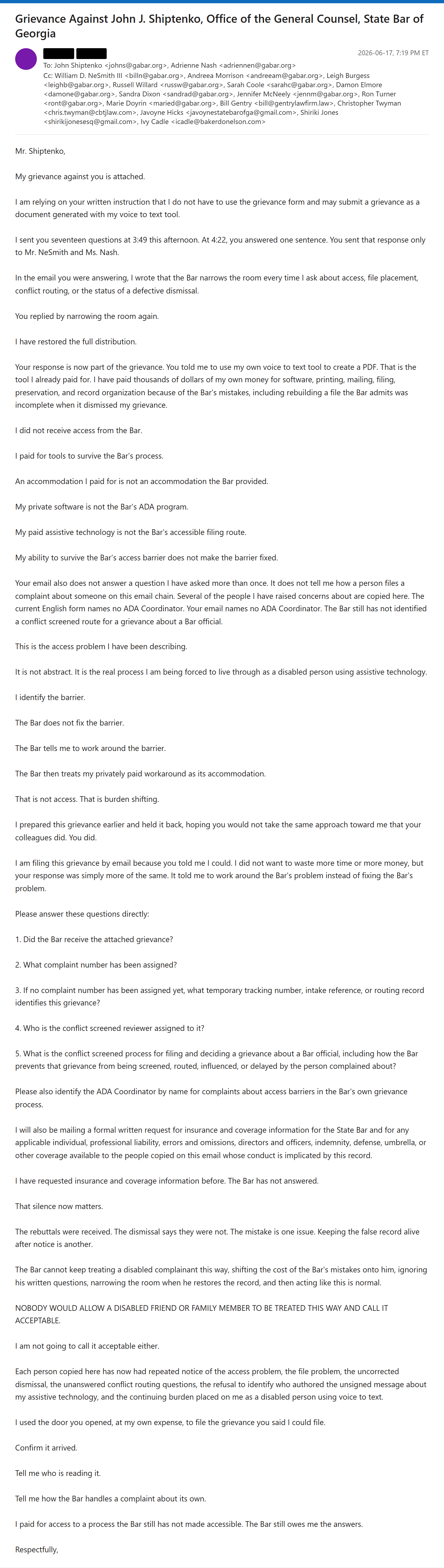
On June 17, 2026, I emailed ADA Coordinator John J. Shiptenko of the State Bar of Georgia. The email, its date and the people on it are below.
Date: June 17, 2026 ET
From: The complainant
To / Cc: To ADA Coordinator John Shiptenko (JohnS@gabar.org). Cc Deputy General Counsel William D. NeSmith III; Grievance Counsel Adrienne Nash; Deputy General Counsel Andreea N. Morrison; Assistant General Counsel Leigh Burgess; General Counsel Russell D. Willard; Chief Operating Officer Sarah I. Coole; Executive Director Damon E. Elmore; Human Resources Director Sandra Dixon; Governmental Affairs Director Jennifer McNeely; Ron Turner; Marie Doyrin; William C. Gentry; President Christopher P. Twyman; R. Javoyne Hicks; Shiriki Cavitt Jones; Immediate Past President Ivy N. Cadle.
Subject: Grievance Against John J. Shiptenko, Office of the General Counsel, State Bar of Georgia
Attachments: Memorandum grievance (PDF) and exhibit set (PDF).
What was sent: A grievance against John J. Shiptenko, filed by email on June 17, 2026 as a PDF memorandum with an set of attachments, by the alternate route the State Bar of Georgia had said was allowed.
What came back: On June 18, 2026, at 8:05 AM Eastern, John J. Shiptenko answered with one word: “Received.”
What this shows: The complainant filed a grievance against the ADA Coordinator by email on June 17, 2026, using the alternate submission route the Bar had said he could use, and asked for written confirmation of receipt.
What this does not show: This email does not contain any Bar response; it is the complainant’s own transmittal and request for written confirmation.
I filed a grievance against the Bar’s ADA contact, John J. Shiptenko
My grievance against you is attached.
I am relying on your written instruction that I do not have to use the grievance form and may submit a grievance as a document generated with my voice to text tool.
I sent you seventeen questions at 3:49 this afternoon. At 4:22, you answered one sentence. You sent that response only to Mr. NeSmith and Ms. Nash.
In the email you were answering, I wrote that the Bar narrows the room every time I ask about access, file placement, conflict routing, or the status of a defective dismissal.
You replied by narrowing the room again.
I have restored the full distribution.
Your response is now part of the grievance. You told me to use my own voice to text tool to create a PDF. That is the tool I already paid for. I have paid thousands of dollars of my own money for software, printing, mailing, filing, preservation, and record organization because of the Bar’s mistakes, including rebuilding a file the Bar admits was incomplete when it dismissed my grievance.
I did not receive access from the Bar.
I paid for tools to survive the Bar’s process.
An accommodation I paid for is not an accommodation the Bar provided.
My private software is not the Bar’s ADA program.
My paid assistive technology is not the Bar’s accessible filing route.
My ability to survive the Bar’s access barrier does not make the barrier fixed.
Your email also does not answer a question I have asked more than once. It does not tell me how a person files a complaint about someone on this email chain. Several of the people I have raised concerns about are copied here. The current English form names no ADA Coordinator. Your email names no ADA Coordinator. The Bar still has not identified a conflict screened route for a grievance about a Bar official.
This is the access problem I have been describing.
It is not abstract. It is the real process I am being forced to live through as a disabled person using assistive technology.
I identify the barrier.
The Bar does not fix the barrier.
The Bar tells me to work around the barrier.
The Bar then treats my privately paid workaround as its accommodation.
That is not access. That is burden shifting.
I prepared this grievance earlier and held it back, hoping you would not take the same approach toward me that your colleagues did. You did.
I am filing this grievance by email because you told me I could. I did not want to waste more time or more money, but your response was simply more of the same. It told me to work around the Bar’s problem instead of fixing the Bar’s problem.
Please answer these questions directly:
1. Did the Bar receive the attached grievance?
2. What complaint number has been assigned?
3. If no complaint number has been assigned yet, what temporary tracking number, intake reference, or routing record identifies this grievance?
4. Who is the conflict screened reviewer assigned to it?
5. What is the conflict screened process for filing and deciding a grievance about a Bar official, including how the Bar prevents that grievance from being screened, routed, influenced, or delayed by the person complained about?
Please also identify the ADA Coordinator by name for complaints about access barriers in the Bar’s own grievance process.
I will also be mailing a formal written request for insurance and coverage information for the State Bar and for any applicable individual, professional liability, errors and omissions, directors and officers, indemnity, defense, umbrella, or other coverage available to the people copied on this email whose conduct is implicated by this record.
I have requested insurance and coverage information before. The Bar has not answered.
That silence now matters.
The rebuttals were received. The dismissal says they were not. The mistake is one issue. Keeping the false record alive after notice is another.
The Bar cannot keep treating a disabled complainant this way, shifting the cost of the Bar’s mistakes onto him, ignoring his written questions, narrowing the room when he restores the record, and then acting like this is normal.
NOBODY WOULD ALLOW A DISABLED FRIEND OR FAMILY MEMBER TO BE TREATED THIS WAY AND CALL IT ACCEPTABLE.
I am not going to call it acceptable either.
Each person copied here has now had repeated notice of the access problem, the file problem, the uncorrected dismissal, the unanswered conflict routing questions, the refusal to identify who authored the unsigned message about my assistive technology, and the continuing burden placed on me as a disabled person using voice to text.
I used the door you opened, at my own expense, to file the grievance you said I could file.
Confirm it arrived.
Tell me who is reading it.
Tell me how the Bar handles a complaint about its own.
I paid for access to a process the Bar still has not made accessible. The Bar still owes me the answers.
Respectfully,
[Signature block.]
Transcript corrected October 14, 2026 to match the original email. Only names are removed.