A day-by-day diary of what happened when a disabled complainant asked the State Bar of Georgia to correct a dismissal it admitted was issued on a misfiled record, and asked whether the ADA applied to its own process. Every entry links to the actual emails and documents. January to June 2026. Six months, day by day.
Jump to a day
Chapter 1. The grievance and the two rebuttals.
Jan 23 · Jan 28 · Feb 2 · Feb 3 · Feb 20
Chapter 2. The dismissal and the admission.
Apr 10 · Apr 20 · Apr 21
Chapter 3. The ADA request.
Apr 30 · May 4 · May 5 · May 7 · May 11
Chapter 4. The denial and the shutdown.
May 12 · May 13 · May 14 · May 15
Chapter 5. The receipt fight.
May 18 · May 19 · May 20 · May 21 · May 22 · May 26 · May 27
Chapter 6. The pivot and the escalation.
May 29 · Jun 1 · Jun 2 · Jun 8 · Jun 10 · Jun 16 · Jun 17
Chapter 7. The end of the paper trail.
Jun 18 · Jun 26 · Jun 30
Chapter 1. The grievance and the two rebuttals
January 23 to February 20. I used the Bar’s process exactly as the Bar describes it.
January 23, 2026
I filed a grievance with the State Bar of Georgia against a City of Brookhaven contract attorney. I did it in writing, through the Bar’s own intake, the way the Bar tells the public to do it. I was not looking for a fight. I was using the one process Georgia offers when you believe a lawyer’s conduct crossed a line.
Read it: how the grievance began · Back to index
January 28, 2026
The Bar processed the grievance, assigned it a number, and sent it to the attorney to respond. So far, the machine worked. Intake, number, delivery. Five days. Remember that speed. It does not come back.
Read it: how the grievance began · Back to index
February 2, 2026
The contract attorney sent his written response to the Bar. Under the Bar’s own published process, that is the moment the grievant can be invited to rebut. The next step was mine, and I took it the very next day.
Read it: how the grievance began · Back to index
February 3, 2026
I sent my first rebuttal, as the Bar’s process invited. The Bar’s system confirmed delivery. Hold on to that word, confirmed. This entire diary is about what a confirmation from this institution turns out to be worth.
Read it: how the grievance began · Back to index
February 20, 2026
I sent my second rebuttal, by the Bar’s deadline. It was delayed only because the City of Brookhaven had not produced a public record I needed, and I had to obtain it another way. The Bar’s system confirmed delivery again. Two rebuttals. Two confirmations. Both in the Bar’s hands.
Then, for seven weeks, nothing.
Read it: how the grievance began · Back to index
Chapter 2. The dismissal and the admission
April 10 to April 21. Dismissed for a missing rebuttal. Eleven days later, the Bar admitted it had both.
April 10, 2026
The Bar dismissed the grievance, in a letter signed by Deputy General Counsel Andreea N. Morrison, stating no rebuttal had been received. Read that against Chapter 1. Two rebuttals, two delivery confirmations, and a dismissal that says neither one exists. The name of the lawyer the grievance was about is blacked out in the letter as posted here.
Read it: the April 10 dismissal · Back to index
April 20, 2026
I sent the first two emails challenging the April 10 dismissal. I did not argue the merits. I asked the process question: how can a dismissal say no rebuttal was received when your own system confirmed two?
April 20, 2026: My First Two Emails Against the April 10 Dismissal
I sent the first two emails challenging the April 10 dismissal. A 6:39 PM filing to the General Counsel and grievance counsel requested supervisory review and correction, arguing the dismissal rested on a false “no rebuttal” premise. An 8:21 PM email addressed the signing attorney, Deputy General Counsel Andreea N. Morrison, directly.
What had to be true
For the Bar’s dismissal letter to say no rebuttal was received, the rebuttals had to be absent from the file when the signing attorney reviewed it. For me to prove the premise false, the Bar’s own intake system had to have acknowledged receipt of the submissions, which it had (Feb 3 and Feb 20 auto-acknowledgments from Response@gabar.org).
What I argued
- The dismissal’s factual premise is contradicted by the Bar’s own intake system. “The Bar Office’s own system says otherwise.”
- The Bar acknowledged delivery of both submissions; the Feb 20 auto-reply named the case at the moment of receipt.
- “You signed a letter stating that did not happen.”
- An attorney who signs a dismissal stating no rebuttal was received, when the office acknowledged it, “has made a statement that is not true.”
- The same office enforces the honesty rules against the lawyers it investigates; “the signature is the responsibility.”
- The request is narrow and procedural: “I am not asking the Office to decide the merits in this email. I am asking the Office to correct the record.”
- Specific corrections demanded: confirm receipt in writing, associate the submissions with the file, “Withdraw or supersede the April 10 dismissal,” conduct a fresh first review, and preserve all intake records and records of where my emails went.
What it cost
I described reconstructing a record the Bar’s own system had already confirmed: “I have spent my own time, my own money, and physical reserves I do not have to reconstruct a record your Office’s own system already confirmed.” He disclosed disability and active medical care while doing so.
I Asked Andreea N. Morrison to Correct the Dismissal She Signed

On April 20, 2026 I sent the first two emails challenging the April 10 dismissal. At 6:39 PM I asked the General Counsel and grievance counsel for supervisory review and correction, arguing the dismissal rested on a false “no rebuttal” premise, when the Bar’s own intake system had already confirmed receipt of both my submissions. At 8:21 PM I wrote the attorney who signed the dismissal, Deputy General Counsel Andreea N. Morrison, directly.
April 21, 2026
The Bar responded for the first time, and the response is the most important document on this site. Assistant General Counsel Leigh Burgess admitted, in writing: “As a result of this misclassification, your submissions were not added to the grievance file at that time.” They had my rebuttals. Staff mislabeled them. They were not in the file when the dismissal went out. The file was not in the file.
April 21, 2026: Leigh Burgess, State Bar of Georgia, Answered My April 20 Emails
On April 21, 2026, Leigh Burgess of the State Bar of Georgia confirmed my February emails were missing at review and said they had been added to the file.
The scoreboard, as of April 21, 2026
| My emails to the State Bar of Georgia on April 20, 2026 | 2 |
| Replies from Leigh Burgess on April 21, 2026 | 1 |
| My emails on April 21, 2026, after her reply | 4 |
| February emails of mine the State Bar of Georgia confirmed receiving | 2 |
What the Bar said
Leigh Burgess, Assistant General Counsel, State Bar of Georgia, April 21, 2026. Proof of Leigh Burgess writing it: her April 21, 2026 email, every word

Read the text transcript
From: Leigh Burgess
To: [my name removed]
Cc: Leigh Burgess
Sent: April 21, 2026, 11:53 AM ET
Subject: FW: [External] Grievance No. [number removed] — Correction of April 10 Dismissal and Request for Recusal
4 files attached.
Mr. [my name removed],
Ms. Morrison forwarded your email to me for direct response. I supervise the staff responsible for monitoring the Response@gabar.org mailbox.
You are correct that we received emails from you on February 3, 2026, and February 20, 2026. However, because your messages were labeled as a “Supplemental Submission in Support of Grievance,” they were not processed as rebuttals and were instead treated as unsolicited submissions. As noted in the automatic reply from the response mailbox, our office is unable to process unsolicited supplemental materials after a grievance has been submitted and can only accept responses from attorneys or rebuttals from complainants. The notice also advises that responses and rebuttals should be submitted in a single, complete email rather than in multiple messages.
As a result of this misclassification, your submissions were not added to the grievance file at that time. Accordingly, when Ms. Morrison reviewed the file, no rebuttal was present. I have taken steps to address this issue to help ensure it does not occur in the future.
Your previously submitted materials, referred to in your correspondence as “supplemental evidentiary briefs,” have now been added to the file. Because the grievance has already been dismissed, your recent email to Ms. Morrison will be treated as a Request for Reconsideration of Dismissal. This process allows for a dismissed matter to be reviewed again to determine whether sufficient evidence exists of a violation of the Georgia Rules of Professional Conduct.
At this stage, the file is considered complete. It now includes your grievance, the attorney’s response, your rebuttal materials, and your request for reconsideration. In accordance with Office of the General Counsel procedures, the matter will be assigned to a different attorney for a full and independent review. You will be notified in writing once a determination has been made. If additional information is needed, we will contact you.
In your correspondence to Ms. Morrison, you also stated that your letter serves as a request for disability-related accommodation. Grievance Counsel reviews and manages such requests as part of the grievance process, coordinating with Bar Counsel as appropriate to ensure accessibility and compliance. At this time, your participation is not required, as the file is complete. Should further input from you become necessary, you will receive instructions at that time, along with the opportunity to submit any accommodation requests.
I apologize for the oversight and appreciate your patience. To reiterate, your file is now complete and will be reviewed in light of your timely submissions as part of the reconsideration process.
Sincerely,
Leigh Burgess
LEIGH BURGESS //
Assistant General Counsel
104 Marietta St. NW, Suite 100 | Atlanta, GA 30303
T: 404-526-8633 | F: 404-527-8744 | leighb@gabar.org
Typed from the native message. Names, my contact details and file numbers are removed and marked in brackets. Nothing else is changed.
On April 21, 2026, Leigh Burgess, Assistant General Counsel for the State Bar of Georgia, sent the first reply to my April 20 emails. Burgess confirmed that the State Bar of Georgia received my February 3 and February 20 emails and had not added them to the grievance file at that time.
The same day, I sent four emails splitting the case into tracks: a merits/reconsideration letter, a separate ADA Title II letter, a direct letter to the signing attorney, and an institutional-notice letter to the Bar President.
Correction, October 12, 2026: An earlier version described April 21, 2026, as the State Bar of Georgia’s first response. April 21 was the first reply to my April 20 emails. Earlier communications included the February 3 invitation to submit a rebuttal, the February 24 acknowledgment, and the April 10 dismissal letter.
The clock, April 20 and 21, 2026 (Eastern time)
| Date and time | Who and what |
|---|---|
| April 20, 6:39 PM | Me: email to the State Bar of Georgia |
| April 20, 8:21 PM | Me: email to the State Bar of Georgia |
| April 21, 11:53 AM | Leigh Burgess: reply to my April 20 emails. “At this time, your participation is not required, as the file is complete.” |
| April 21, 6:43 PM | Me, email 1 of 4: “The Office’s non-response to the six enumerated ADA Title II accommodation requests in the April 20, 2026 Principal Filing” |
| April 21, 6:44 PM | Me, email 2 of 4 |
| April 21, 6:48 PM | Me, email 3 of 4 |
| April 21, 6:53 PM | Me, email 4 of 4 |
What I argued
- The Bar’s April 21 response left the dismissal in place; “A forward is not a correction.”
- Demanded the Bar state whether it would “withdraw or supersede the April 10 dismissal.”
- At 6:43 PM on April 21, 2026, I wrote about “The Office’s non-response to the six enumerated ADA Title II accommodation requests in the April 20, 2026 Principal Filing” and attached an audit of the Bar’s public web pages. Earlier that day, at 11:53 AM, Leigh Burgess wrote: “At this time, your participation is not required, as the file is complete.”
- Set a deadline to fix it: “The cure window closes on May 5, 2026.”
What had to be true
My emails on April 21, 2026, after her reply
As of April 21, 2026
The documents from this day
Chapter 3. The ADA request
April 30 to May 11. I asked for the minimum a disabled person needs to use a paper process. Running unanswered questions after April 30: five.
April 30, 2026
I sent a comprehensive ADA accommodation package and a companion conflict-screen demand. I write with voice software, so what I asked for was basic: written communication, accessible formats, confirmation that documents reach the file, and one reliable person to send things to. I also asked the obvious structural question: when the complaint concerns the Bar’s own handling, who outside that office reviews it?
April 30, 2026: ADA Accommodation Package and Conflict Screen Demand
I sent a comprehensive ADA accommodation package and a companion conflict-screen demand. ADA Coordinator John J. Shiptenko was designated as a contact around this date.
What had to be true
For a conflict-screen demand to be warranted, the office reviewing the case had to be the same office whose own staff conduct was now in question. For the accommodation package to be “comprehensive,” the prior five accommodation requests had to have gone unanswered.
What it cost
A sixth accommodation request after five unanswered ones. I was assembling a 20-page binder of documents and conflict-screen demand while in active medical care, the burden of having to formalize and document access requests the Bar had not acted on.
The documents from this day
- I demanded a written conflict screen and a conflict-free reviewer
- I sent a time-sensitive ADA accommodation request and flagged a new problem with where my emails went
- I asked the Bar for help finding an accessible way to file
- The State ADA Coordinator’s office responded
- I put the Bar on notice of its ADA Title II duties and asked it to preserve its records
- I sent the Bar copies of the day’s correspondence for its file
- I sent the Bar a complete record of everything I had filed
May 4, 2026
John J. Shiptenko sent the Bar’s first substantive ADA engagement and granted two accommodations, written communication and accessible electronic formats. An institution was administering disability access. Keep this day in mind. In eight days another lawyer in the same office will deny the law behind it applies at all.
Read it: the accommodations granted · Back to index
May 5, 2026
Leigh Burgess sent operational answers to the April 30 questions and confirmed the misclassification a second time. The admission was not a slip. It is in writing twice, from the same office, in writing.
May 5, 2026: Burgess Answers and Confirms the Misclassification Again
What the Bar said
Burgess confirmed the Feb 3 and Feb 20 submissions and original grievance “will be thoroughly reviewed during the reconsideration process,” and explained reviewer assignment runs by “alphabetical distribution” by the accused lawyer’s last name. She added, “Please note that OGC@gabar.org is not an email address associated with our office,” flagging the unreliable address the complainant had been using.
The documents from this day
May 7, 2026
Shiptenko sent a substantive point-by-point reply to my access concerns. Engagement, on paper. But the two questions that mattered, whether the April 10 dismissal would be corrected and what a receipt actually means, stayed open. Running count of unanswered questions after this week: eleven.
May 7, 2026: Shiptenko Answers My Access Concerns Point by Point
Shiptenko sent a substantive point-by-point reply to my access concerns. This is the last substantive engagement from Shiptenko for a stretch.
What had to be true
For Shiptenko to answer “no single, designated ADA contact,” the Bar had to concede it had no single published contact and was assigning one ad hoc to this case.
What the Bar said
Shiptenko: “As the ADA Coordinator, my duty is to make sure that the State Bar does not discriminate against you due to your disability,” and “I will help ensure that you have the same rights and opportunities as non-disabled grievants.” He stated a public entity “can have numerous ADA coordinators,” that “Ms. Nash usually handles ADA requests for the grievance process,” and that he had spoken with “Ms. Stacey Peace, State ADA Coordinator,” and was “analyzing our ADA notices and processes to determine whether and how they can be improved.” He offered to route all grievance communication through Nash if desired.
What it cost
My listed concerns are themselves the burden record: I documented that I was receiving “answers from different people, on different days,” forcing me to track and reconcile multiple inconsistent institutional channels.
The documents from this day
May 11, 2026
I sent two letters, a full response to Shiptenko’s May 4 and May 7 emails, and a final institutional cure demand to the General Counsel, both setting a single cure deadline. I told them plainly what would fix this: correct the file the Bar itself admitted was wrong. Unanswered questions after today: thirteen.
May 11, 2026: My Full Reply to Shiptenko and a Final Cure Demand
I sent two letters: a full response to Shiptenko‘s May 4 and May 7 emails, and a final institutional cure-demand to the General Counsel, both setting a single cure deadline.
What had to be true
For a “cure” demand to make sense, an uncured defect had to remain: the April 10 dismissal had to still be operative despite the admitted misclassification.
What I argued
- Requested a single coordinated written response “by May 14, 2026, 17:00 ET” so there is “one shared record going forward.”
- Asked the Bar to state the procedural status of the April 10 dismissal and whether it “may fairly be described as a complete-record merits determination.”
- Restated the load-bearing admission and asked the Bar “to correct the procedural record internally before the cure window closes.”
The documents from this day
Chapter 4. The denial and the shutdown
May 12 to May 15. Four days that changed what this story is about.
May 12, 2026
Deputy General Counsel William D. NeSmith III issued a written ADA coverage denial at 2:12 PM. It said the Bar is not a public entity and need not publish an ADA Coordinator. It questioned whether I needed help at all, writing that “it does not appear that you require assistance in preparing written submissions or otherwise accessing the grievance or reconsideration process.” And it suggested my ADA request “may be directed less toward obtaining accommodation or access assistance and more toward securing a particular substantive outcome regarding the underlying grievance matter.” The email was sent to me only, with every other recipient stripped off the thread.
Read it: the coverage denial · Back to index
May 13, 2026
A dense single day. A call was offered for 11:30, then withdrawn the next morning. Shiptenko wrote that the Bar had “approved your accommodation request.” So on May 12 the ADA did not apply to the Bar, and on May 13 the Bar was approving accommodations under it. Both positions are in writing, one day apart.
May 13: NeSmith Retracted the Meeting. Shiptenko Approved My Request
A dense single day. NeSmith (7:34 AM) retracted the meeting, saying it “was meant for a colleague of mine and was sent to you in error.” Shiptenko (12:08 PM) confirmed an approved accommodation and a reconsideration postponement to June 15. NeSmith (12:41 PM) partially restored cc but again stripped the State ADA Coordinator; NeSmith (1:29 PM) said he had a doctor’s appointment and would respond “tomorrow.” The Georgia State ADA Coordinator’s Office replied on the full list, treating the concerns as legitimate. I sent a detailed reply documenting the solo-email pattern.
What had to be true
For NeSmith’s denial and Shiptenko’s grant to coexist, two Bar officials had to be holding opposite institutional positions on the same day about the same person. For the “tomorrow” promise to matter, a self-imposed Bar deadline had to exist and then pass.
What I argued
- The retraction proved the need for one point of contact: “The last twelve hours proved exactly why a single point of contact was the focus of my requests.”
- Documented the solo-email pattern as escalating: “One solo email can be a mistake. Two is careless. Three is a pattern. Four is a choice. Five, after five documented requests to stop, is not confusion. It is harassment.”
- Framed the rebuild cost as a prohibited surcharge: every solo email “forces me to reconstruct the distribution,” and “That cost, imposed on me because of my disability and after written notice, is the surcharge prohibited by 28 C.F.R. Section 35.130(f).”
- “Silence is not a written determination” under 28 C.F.R. Section 35.164.
- The 15 clarification questions, the 11 institutional confirmation questions, and the preservation demand “remain operative and unanswered.”
What the Bar said
NeSmith (7:34 AM): “The 11:30 time was meant for a colleague of mine and was sent to you in error… there is no meeting between you and I at 11:30.” Shiptenko (12:08 PM): “The State Bar has approved your accommodation request,” with Nash to “defer her final determination until June 15, 2026.” NeSmith (1:29 PM): “I won’t be able to respond to your two emails until tomorrow.” The Georgia State ADA Coordinator’s Office replied on the full list confirming the Bar’s obligations for “programs, services, and activities” and treating the case as legitimate.
The documents from this day
- The Bar replied about the meeting
- I confirmed the meeting and asked for the access and dial-in details
- I confirmed the meeting and asked for the access and dial-in details
- The Bar approved my accommodation request
- The Bar replied about the meeting
- The Bar replied about the meeting
- I documented the Bar’s own words and its silence after the deadline I gave them to fix it passed
May 14, 2026
Cure-window day. The deadline I set for the Bar to correct its own admitted error came and went. I also notified the Bar that my surgery had been postponed because I could not clear preop. Shiptenko was copied. Remember that. The Bar will later build a delay narrative around a recovery timeline it was told, in writing, did not happen on schedule.
May 14, 2026: The Deadline I Gave Them to Fix It Passed. NeSmith’s ‘Tomorrow’ Never Came
Cure-window day. I sent a morning reminder with a quote sheet of the Bar’s own words and five written questions, and an evening post-cure record documenting that nothing was cured. NeSmith‘s promised “tomorrow” response did not arrive. The deadline I gave them to fix it passed at 5:00 PM ET.
What had to be true
For “zero cured” to be true, the Bar had to leave the dismissal status unstated and the contradiction unresolved through the deadline. For “who speaks for the Bar” to be a fair question, the Bar’s own emails over ten days had to contain opposite positions.
What I argued
- Asked leadership to identify, in writing, “Whose statements reflect the official position of the State Bar of Georgia,” “The operative status of the April 10, 2026 dismissal,” the reconsideration’s “terms, scope, and completion timeline,” whether new evidence may be presented, and who must inform the accused lawyer’s counsel of the operative status.
- Documented the contradiction: Shiptenko, “The State Bar has approved your accommodation request”; NeSmith, “The State Bar of Georgia is not a public entity, such as a federal, state or local government department or agency.”
- Recorded the post-cure tally: 28 items identified, 4 violations, “Zero items have been cured.”
- Escalation notice: if the Bar will not provide a unified written response, “I will seek assistance from disability rights advocacy organizations, ADA legal clinics, and media outlets.”
What the Bar said
None on this date. NeSmith’s promised “tomorrow” response did not come.
The documents from this day
May 15, 2026
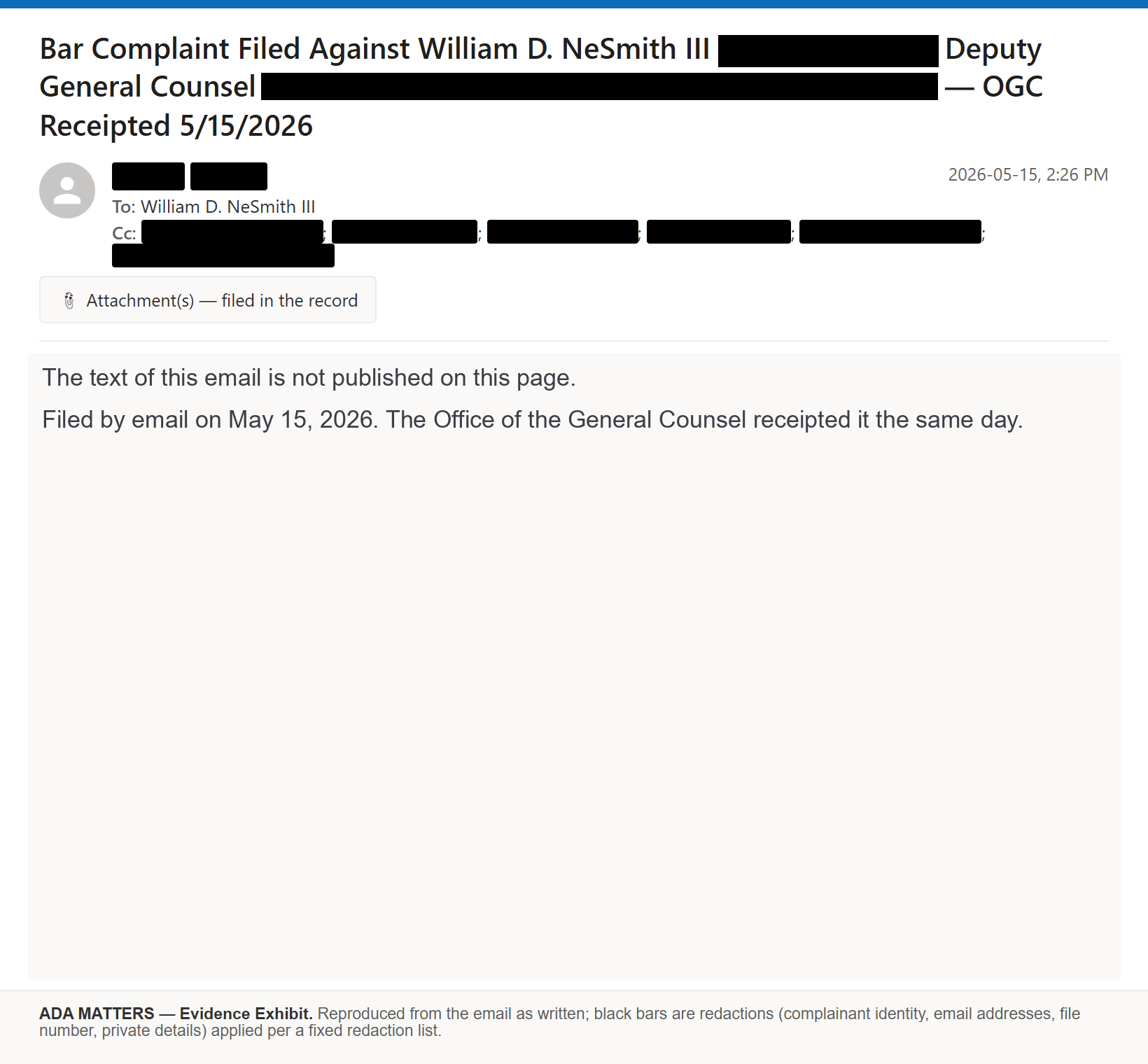
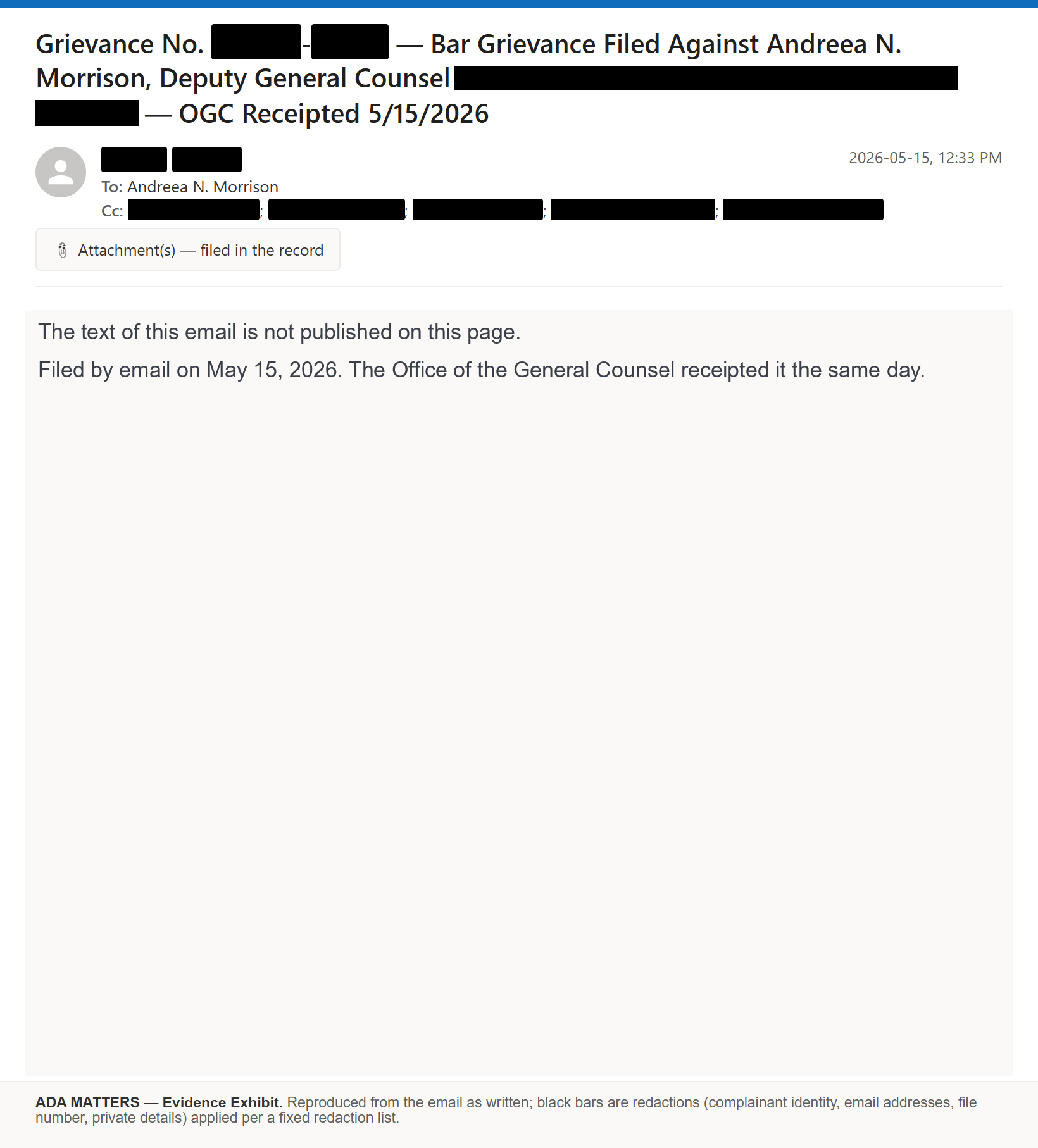
I filed grievances against two Bar officials, Deputy General Counsel Morrison, who signed the April 10 dismissal, and Deputy General Counsel NeSmith, who wrote the May 12 denial, and sent notice emails. The same day, correspondence was shut down from the Bar’s side. Fifteen questions were now open. The number stops moving here, because the answers do.
May 15, 2026: I Filed Grievances Against Morrison and NeSmith
I filed grievances against two Bar officials (Deputy General Counsel Morrison and Deputy General Counsel NeSmith) and sent notice emails. Filing required family assistance because a CAPTCHA barrier blocked independent filing. NeSmith (11:05 AM) sent a litigation-threat shutdown letter restricting further substantive correspondence.
What I argued
- The Bar shifted blame instead of fixing the file: “The Office blamed my labeling for its own routing failure.”
- “The Bar cannot simultaneously grant Title II accommodations and deny Title II coverage. One of those statements is institutionally false.”
- Structural conflict: the office “cannot screen a grievance against its own Deputy General Counsel without a structural conflict.”
- Asked the central question: “What is the institutional interest served by leaving a self-admittedly defective dismissal in place against a disabled complainant?”
- Stated I would have preferred not to escalate: “I tried to facilitate this privately but have been refused any single point of contact by the Ga Bar.”
What the Bar said
NeSmith (11:05 AM): “You have now expressly threatened litigation against the State Bar of Georgia,” and therefore “the State Bar of Georgia will not engage in further substantive correspondence with you… outside formal legal process.” He confined further contact to accommodation requests (to Shiptenko) and reconsideration evidence (to Nash).
What it cost
I could not file on my own: the CAPTCHA barrier meant “access depended on another person’s schedule, not [my] choice,” forcing all filings into a single session whenever a family helper was available. My access efforts were then recharacterized as a litigation threat and used to cut off correspondence.
The documents from this day
I Filed a Grievance Against William D. NeSmith III
I filed a grievance against Deputy General Counsel Andreea N. Morrison
Chapter 5. The receipt fight
May 18 to May 27. It took three written requests to learn whether one document reached one file. Unanswered questions: fifteen, and holding.
May 18, 2026
I sent Shiptenko a comprehensive ADA access and receipt-confirmation inquiry about the portal grievances, and a separate supplemental-evidence transmission to Grievance Counsel Adrienne Nash requesting receipt confirmation. After April 10, I do not treat receipt as a formality. This institution has already shown me a document can be received and still not exist.
May 18, 2026: My ADA Access Inquiry to Shiptenko, My Evidence to Nash
I sent Shiptenko a comprehensive ADA-access and receipt-confirmation inquiry about the portal grievances, and a separate supplemental-evidence transmission to Nash requesting receipt confirmation. The Bar’s directory also failed on the same day (an internal address bounced).
What I argued
- This is an access request, not a merits request: “It is an ADA access and process-confirmation request.”
- Asked whether a published ADA grievance procedure exists, and for a “non-CAPTCHA filing route.”
- Requested written response “within five business days. Please do not call me or require a telephone call.”
What it cost
I had to itemize, point by point, every access failure (CAPTCHA, autoresponder, unreliable address, form discrepancy) because the Bar had given him no reliable confirmation route, repetition forced by the absence of a built-in confirmation system. For the Nash transmission he had to disclose that prior submissions “were acknowledged as misclassified and not placed in the grievance file” to justify asking for confirmation at all.
May 19, 2026
I sent Shiptenko a stand-alone receipt and file-association confirmation request for the prior day’s transmission. One question. Did it arrive, and is it in the file.
May 19, 2026: I Asked Shiptenko to Confirm Receipt and File Placement
I sent Shiptenko a stand-alone receipt-and-file-association confirmation request for the prior day’s transmission. The Bar’s Response@gabar.org sent an unsigned confirmation of the three portal grievances and laid out a restricted correspondence regime. (A Willard email about where to send things is also logged this date in the documents.)
What had to be true
For me to have to ask “whether the mail arrived,” the Bar had to have no reliable, automatic confirmation for evidence sent outside the portal.
What I argued
- Receipt confirmation is now a disability accommodation, not a courtesy: it “is now an access safeguard for me, not an optional courtesy.”
- The prior admission is the reason: “As a result of this misclassification, your submissions were not added to the grievance file at that time.”
- “This is the institutional equivalent of asking whether the mail arrived.”
What the Bar said
The unsigned Response@gabar.org email confirmed receipt of the three grievances and itemized what was received per grievance. It restricted the complainant’s correspondence: “No request for information as to status, procedures, or other matters beyond a withdrawal or request to supplement will be processed,” and suggested the complainant’s reliance on a non-office address may have come from “an AI-generated summary answer for a search query.” It reaffirmed the two granted accommodations and sent all accommodation requests to Shiptenko.
The documents from this day
May 20, 2026
Shiptenko replied that he had received the prior transmission only “as a courtesy copy” and told me to contact Nash directly. The ADA contact for my case, receiving my evidence, described himself as a courtesy recipient. The guesswork about where to send things I had asked the Bar to eliminate was now the Bar’s answer.
May 20, 2026: Shiptenko Calls My Evidence a “Courtesy Copy”
Shiptenko told me he had received the prior transmission only “as a courtesy copy” and to contact Nash directly. I emailed Nash directly to ask whether his submission was received.
What I argued
- Direct, narrow ask to Nash: “Did you receive my May 18 supplemental evidence submission and its five attachments?”
What the Bar said
Shiptenko (8:31 AM): “I received it as a courtesy copy. You can contact Ms. Nash directly to verify her receipt. Thank you.”
The documents from this day
May 20, 2026: I Asked Nash Whether My May 18 Evidence Arrived

Respectfully, ██████ ███████
John J. Shiptenko Said He Got My Evidence “as a courtesy copy”

May 21, 2026
I sent a third request for receipt confirmation, labeled exactly that, THIRD REQUEST. Three written asks to confirm one document reached one file, at the agency that dismissed my grievance the last time a document did not reach a file.
May 21, 2026: I sent a “THIRD REQUEST” for receipt confirmation
I sent a “THIRD REQUEST” for receipt confirmation. Nash (5:25 PM) confirmed receipt but reported one attachment could not be opened. I resent the file in accessible format.
What had to be true
For me to label it a “third request,” I had to have asked twice already without a substantive confirmation.
What I argued
- The repetition itself is the point: the subject line escalates to “THIRD REQUEST.”
- Cooperative on the inaccessible file: resent it in alternate format so it “can be opened without any problems.”
What the Bar said
Nash (5:25 PM): “I have received the additional information you requested to be included in your grievance,” noting all attachments were accessible except one, which “could not be opened,” and inviting a resend. The accessible ones “have been added to your file for review.”
May 22, 2026
Nash confirmed the resent attachments were accessible and added to the file. It took four days and three requests, but this time the confirmation named the file. That is what I had been asking the Bar to do since April: say the words, it arrived and it is in the file.
May 22: Adrienne D. Nash Confirms My Attachments Reached the File
Nash confirmed the resent attachments were accessible and added to the file. I sent a brief thank-you.
What I argued
- Courtesy close: “Great, thank you so much! I hope you enjoy your long weekend.”
What the Bar said
Nash (11:44 AM): “I received both of your recent attachments, and I was able to access them. They will also be added to the file for review.”
The documents from this day
May 26, 2026
I sent Shiptenko a consolidated follow-up with fifteen open process and ADA access questions in one ledger. One document, numbered, so nothing could be lost, misclassified, or answered around. The same thread carried my report that the Bar’s own grievance form was a barrier, including a CAPTCHA my assistive technology could not reliably clear.
May 26, 2026: I Sent Shiptenko 15 Open Questions in One Ledger
I sent Shiptenko a consolidated follow-up with fifteen open process and ADA-access questions in one ledger. Shiptenko replied twice: acknowledging receipt, and then sorting the questions out of my lane.
What had to be true
For the questions to be “sorted” away, the Bar had to treat most of my process questions as outside the ADA channel, leaving no single official answering them.
What I argued
- Consolidated fifteen open questions “into one document for your convenience,” to make them easy to answer in one place.
What the Bar said
Shiptenko (2:01 PM): “I have noted your complaint regarding the non-Captcha route for disabled users,” “I have also noted your concerns regarding the differences in the Spanish and English forms,” and “I hope to respond this week.” Shiptenko (3:42 PM): “Questions 1 through 5 and 10 through 15 are not related to addressing discriminatory treatment of you,” so they “must direct those questions to [NeSmith‘s] attention,” pointing back to NeSmith’s May 12 and May 15 emails for the rest.
The documents from this day
May 27, 2026
I reduced the coverage question to one word and sent Shiptenko a threshold yes or no request with a Friday deadline. Does Title II of the ADA apply to the State Bar of Georgia. Yes or no. After a month of moving positions, I asked for one syllable.
May 27, 2026: I Asked Shiptenko One Yes or No Question by Friday
I reduced the coverage question to one word and sent Shiptenko a threshold yes/no request with a Friday deadline.
What I argued
- The single threshold question: “Does the State Bar of Georgia agree that Title II of the ADA applies to access to its attorney-grievance process, yes or no?”
- Distinguished ordinary correspondence costs from “institutional correction work shifted onto” I by the Bar’s file-placement failure.
- Requested a written yes/no “by Friday, May 29, 2026, at 5:00 p.m. Eastern.”
What the Bar said
None on this date (the deadline pointed to May 29).
What it cost
I recorded “the health, family, money, software, and limited-capacity burden caused by the Bar’s admitted file-placement failure,” and the work of compiling eighteen contradictory positions just to pin down one yes/no answer.
The documents from this day
Chapter 6. The pivot and the escalation
May 29 to June 17. The one-word answer never came. The audience got bigger.
May 29, 2026
Shiptenko answered the yes or no question with a litigating position rather than a yes or a no, writing that the Bar is “not subject to Title II” and pivoting to Title III. Count the positions now in writing: accommodations granted under the ADA, not a public entity, not subject to Title II, and now Title III. The question was one word. The answer was a moving target.
Read it: the non-answer · Back to index
June 1, 2026
I sent a follow-up reporting that a grievance I filed against a Bar official produced no confirmation at all, because I could not use the portal and the alternate route generated no receipt. The form was the barrier I had already reported, and the workaround was a black hole. A disabled complainant should not need luck to find out whether his filing exists.
June 1, 2026: My Grievance Against a Bar Official Got No Receipt
I sent a follow-up reporting that a grievance I had filed against a Bar official produced no confirmation at all, because I could not use the portal and the alternate route generated no receipt.
What had to be true
For there to be “no confirmation,” the only automatic-confirmation route (the portal) had to be incompatible with my assistive technology, leaving me dependent on a third party who was unavailable.
What I argued
- The intake system has now failed on the same access issue more than once. The on-disk draft states: “This is the second time the Bar’s intake system has failed me on the same access issue.” (The Question Ledger renders the sent line as “This is the third time in four months I have had to chase confirmation that the Bar received what I sent.”)
- “I could not use the portal. The portal is not compatible with the assistive technology I use to file.”
- Three written demands: confirmation of receipt with date and time; “An accessible way to file and to receive confirmation of receipt that does not require me to depend on a third party”; and the Bar’s record of receipt.
- The principle: “A disabled person should be able to file a complaint and know it arrived. I should not have to ask twice.”
What the Bar said
Addressed in the June 2 reply (below).
What it cost
I had to prove delivery of my own complaint a second time, and document that I depends on a third party to file at all: “I have relied on a third party to help me complete portal submissions. That person was not available when I needed to file.” The repetition (“I should not have to ask twice”) is the burden in my own words.
June 2, 2026
Shiptenko replied confirming receipt of the grievance against a Bar official, narrowed my role on the thread to accommodation requests only, and announced he would be out of office. Receipt confirmed, scope shrunk, contact leaving. All in one email.
June 2, 2026: Shiptenko Confirms the Grievance, Limits His Role
Shiptenko replied confirming receipt of the grievance against a Bar official, narrowed my own role to accommodation requests only, and announced I would be out of office.
What the Bar said
Shiptenko: “correspondence to me regarding the grievance process should only be used to submit requests for accommodations under the ADA. I do not read anything in either of your emails as containing a request for additional accommodations.” He confirmed receipt of the two PDF submissions, said the grievance “will be reviewed by a member of the State Disciplinary Board,” and pointed to the response@gabar.org withdrawal/supplement convention.
What it cost
Not applicable for this date (no outbound). Note: the access failure raised on June 1 was met by narrowing the contact’s role rather than fixing the intake route.
The documents from this day
June 8, 2026
I escalated to Human Resources, sending a misconduct, harassment, and retaliation ADA complaint against three lawyers in the Bar’s Office of the General Counsel, NeSmith, Morrison, and Burgess, to the Director of Human Resources and eleven leadership and Board officers, with an immediate preservation demand. If the office handling the complaints is the subject of the complaints, the complaint has to go over the office.
June 8, 2026: My Complaint to Bar HR, Copied to 11 Officers
On June 8, 2026, I filed a complaint with the State Bar of Georgia’s Director of Human Resources by email, copied to eleven leadership and Board officers, with a preservation demand.
What I argued
- The Bar treated an access request as pretext: “I asked for help. The State Bar treated that request as pretext, in its own words.”
- Quoted NeSmith’s recharacterization back at the institution: “it does not appear that you require assistance,” and the request “may be directed less toward obtaining accommodation or access assistance and more toward securing a particular substantive outcome regarding the underlying grievance matter.”
- Constructive-notice line to leadership: “You are not learning of this for the first time. On June 2, I put the Executive Director, the Chief Operating Officer, you… on the same written record.”
- Demanded confirmation/preservation/conflict-screen by close of the next business day (June 9).
What the Bar said
No substantive response by the June 9 deadline. Read receipts surfaced from Chief Operating Officer Sarah I. Coole (June 8, 5:40 PM ET) and Immediate Past President Ivy N. Cadle (June 9), confirming executive-level reading.
What it cost
I had to assemble a 14-page formal HR complaint and escalate to a dozen officials to be heard, after the line-level channels had recharacterized my access requests. I disclosed the personal toll: “In April 2026 alone, I had two surgeries and two hospitalizations while dealing with this matter.”
I escalated to Human Resources

On June 8, 2026 I escalated to Human Resources. I sent a misconduct, harassment, and retaliation ADA complaint to the Director of Human Resources, copying eleven leadership and Board officers, with an immediate preservation demand.
It named three Office of the General Counsel lawyers: William D. NeSmith III, Andreea N. Morrison, and Leigh Burgess. When the process inside the office broke, I went over it.
June 10, 2026
Shiptenko sent a proactive status update on the reconsideration, stating the postponement ran to June 15 and expressing a hope about my surgery. A polite email built on a timeline the Bar had chosen and a recovery the Bar had been told, on May 14, in writing, with Shiptenko copied, did not happen on schedule.
June 10, 2026: Shiptenko Says the Postponement Runs to June 15
Shiptenko sent a proactive substantive status update on the reconsideration, stating the postponement ran to June 15 and expressing a hope about my surgery.
What had to be true
For the status update to be “proactive,” the Bar had to be willing to engage on substance when it served the Bar, days after telling I it read nothing in my emails as an accommodation request.
What the Bar said
Shiptenko: “the State Bar approved your accommodation request, and Ms. Nash… has postponed issuing a final decision until June 15, 2026, at which point she will resume her review of that matter,” and “I hope you have recovered well from your surgery.”
What it cost
Not applicable for this date (no outbound). Note: the “recovered well from your surgery” line is factually off; I had told the Bar on May 14, with the ADA Coordinator copied, that the surgery was postponed because I could not clear preoperative requirements.
John J. Shiptenko Told Me the Postponement Runs to June 15

I hope you have recovered well from your surgery.
Thank you.”
June 16, 2026
I waited until past the June 15 date the Bar itself had set, then sent a consolidated reconsideration reply with twenty-four written questions and attachments to Shiptenko and the full leadership group. Same day, the twenty-four questions were sent to Nash and the leadership copy list was stripped from the reply. Every time the audience grew, someone at the Bar made it smaller.
June 16, 2026: I Put 24 Questions to State Bar of Georgia Leaders
I sent a consolidated reconsideration reply with twenty-four written questions and attachments to Shiptenko and the full leadership group, after waiting until past the June 15 date the Bar had given. Shiptenko replied the same day, answering none of the questions, sending them to Nash, and stripping the leadership cc.
What I argued
- Asked the Bar “to confirm receipt and identify who will read and answer the response.”
- Asked that “if any portion will not be processed because the Bar considers it outside an assigned role, the Bar identify that portion and the person responsible.”
What the Bar said
Shiptenko (1:44 PM): “Ms. Nash can answer your questions regarding the reconsideration,” noted Nash “has resumed her review,” and attached a blank grievance form with three CAPTCHA-free filing options. He answered none of the twenty-four questions and identified no declined portion.
What it cost
I timed my send to respect the Bar’s own June 15 date, then compiled twenty-four questions and attachments, only to have the entire set sent to a different person, the consolidation work again returned without substantive answers.
The documents from this day
June 17, 2026
I sent a final hybrid reply listing the outstanding ADA compliance issues and unanswered questions, contrasting the Spanish and English grievance forms and the Bar’s silence against other agencies’ timeliness. The same day, the Bar’s reply pointed to my “voice-to-text tool” as an available aid. The tool I bought. With my money. Years ago. The Bar’s ADA answer was, in the end, equipment I already owned. That evening I filed a grievance concerning the ADA Coordinator’s own handling, using the self-document route the Bar’s own June email had described.
State Bar of Georgia Left My Questions Open. Other Agencies Answered
I sent a final hybrid reply listing the outstanding ADA-compliance issues and unanswered questions, contrasting the Spanish and English grievance forms and the Bar’s silence against other agencies’ timeliness. Shiptenko replied 34 minutes later addressing only the grievance-form point and again stripping the leadership cc.
What had to be true
For the form to be the only thing answered, the Bar had to keep treating the access mechanics as the issue while leaving the substantive questions (the uncorrected dismissal, who is reviewing, the unsigned May 19 author) unanswered.
What I argued
- Pressed the core unanswered items: who is reviewing the correction, by what standard, in what timeframe; the unsigned May 19 author; the withdrawn meeting; the non-correction of the dismissal.
- The closing line ties it back to Day 1: “The April 10 dismissal still says no rebuttal was received. I sent two.”
What the Bar said
Shiptenko (4:22 PM): “You don’t have to use the grievance form to file a grievance. You appear to have the ability to use your voice-to-text tool to create a PDF,” and “we are happy to accommodate you by accepting a grievance document generated with your existing voice-to-text tool… We just request that you do your best to include the information requested on the grievance form.” It addressed one point and ignored the rest.
What it cost
I had to compile a final outstanding-issues letter (seventeen-plus questions) to show the substantive record was still unanswered, and received a 34-minute reply that handled only the form while the substantive questions continued to draw weeks or silence. The reply also commented on my disability again (“You appear to have the ability to use your voice-to-text tool”), shifting the burden of recreating the form onto me.
The documents from this day
Chapter 7. The end of the paper trail
June 18 to June 30. First and only answers: six of seven cases closed in one day. Of the fifteen questions, answered: zero.
June 18, 2026
At 8:05 AM, Shiptenko acknowledged the grievance filed against him with one word: “Received.” One word, sent to me alone, no one copied. After six months of asking this institution what received means, I finally got the answer in its purest form. It means one word, and nothing after it.
Read it: the one-word reply · Back to index
June 26, 2026
I sent a status demand on all seven open cases, none of which had a decision, under a subject line that said what the documents showed: forty-two days of silence. I restored the full leadership copy list the Bar kept shrinking, and attached the grievance for reference. The same day brought an out-of-office reply sending urgent cases to another staff member, so I forwarded the demand there and asked one question in writing: while the ADA contact is away, who owns my accommodations, and do the granted ones remain in effect.
Read it: the correspondence record · Back to index
June 30, 2026
The answers arrived, all of them, in one day. The reconsideration of the original grievance: denied, with the April 10 no-rebuttal statement still uncorrected. The Westbury grievance: dismissed, with the accused lawyer, a former member of the Bar’s Board of Governors, copied on his own clearance. The Morrison grievance: dismissed. The NeSmith grievance: dismissed. The Shiptenko grievance: dismissed. Six months, fifteen written questions, seven cases, and the Bar’s complete output was one day of dismissal letters on six of them. Questions answered: zero. That is where the diary ends, because that is where the Bar ended it.
Read it: the June 30 decisions · Back to index
Where to go next. Read the full story · See the documents · The open questions · The full timeline